So, you’ve finished your digital marketing course, polished your resume, and now there’s just one thing standing between you and your first job offer — the interview.
And if you’re being honest, that’s the part that scares you the most.
Here’s the good news: you don’t have to walk into that interview room blind. A digital marketing mock interview is one of the smartest, most underrated tools you can use to prepare — and in this blog, we’re going to break down exactly what it is, why it works, and how you can use it to walk into your real interview feeling confident instead of clueless.
Let’s get into it.
What Is a Digital Marketing Mock Interview?
A digital marketing mock interview is basically a practice run of a real job interview. It’s designed to feel as close to the real thing as possible — same kind of questions, same pressure, same format — except there’s no job on the line.
Think of it like a dress rehearsal before opening night.
You sit across from someone (a mentor, trainer, senior professional, or even a friend who knows the field) and they ask you the exact kind of questions a hiring manager would ask. You answer. They give feedback. You improve. Repeat.
The goal isn’t to trick you or make you nervous. It’s to expose the gaps in your knowledge and communication before they cost you a real opportunity.

Why Mock Interviews Actually Matter (More Than You Think)
A lot of students skip mock interviews because they think “I already know the concepts, I’ll just wing it.” That’s a mistake, and here’s why.
1. Knowing a concept and explaining it are two different skills
You might understand what SEO or CPC means perfectly well in your head. But can you explain it clearly, in 30 seconds, to someone who’s testing you? That’s a completely different muscle — and it’s the one interviews actually test.
2. It kills interview anxiety
Nervousness usually comes from uncertainty — not knowing what’s coming next. Once you’ve been through a few mock rounds, the real interview stops feeling unpredictable. You’ve basically seen the movie before.
3. It reveals your weak spots
Maybe you’re solid on social media marketing but freeze up when someone asks about Google Ads bidding strategies. A mock interview shows you exactly where you need to study more — while you still have time to fix it.
4. It sharpens your communication
Digital marketing is a client-facing, presentation-heavy field. Recruiters aren’t just checking your knowledge — they’re checking whether you can communicate ideas clearly and confidently. Mock interviews train exactly that.
5. It builds real confidence, not fake confidence
There’s a difference between “hyping yourself up” and actually being prepared. Mock interviews give you the second kind — the kind that doesn’t crack under pressure.

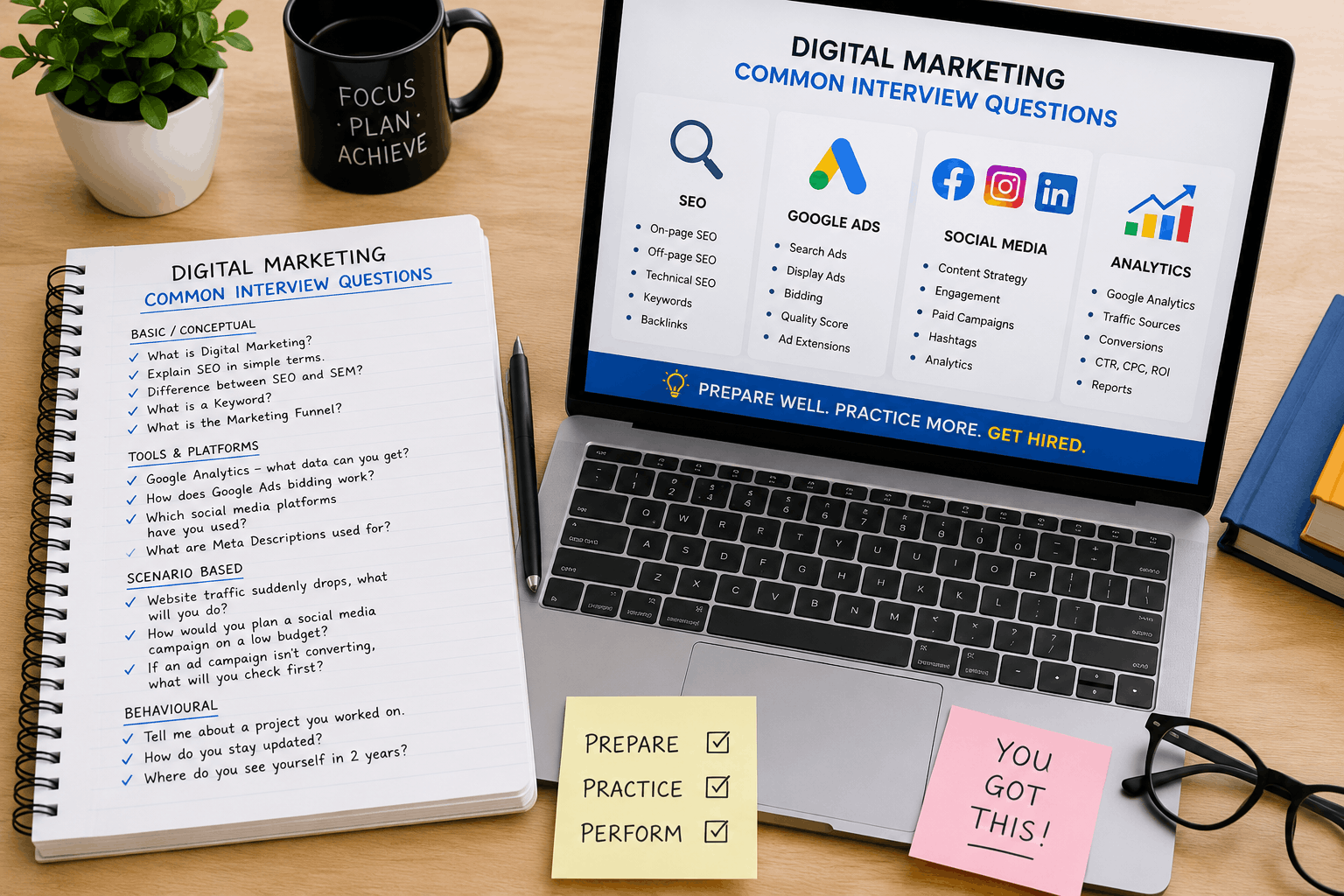
Common Digital Marketing Interview Questions You Should Practice
Let’s get practical. Here are the types of questions that come up again and again in digital marketing interviews for freshers. Use these to structure your mock practice sessions.
Basic / Conceptual Questions
- What is digital marketing, and how is it different from traditional marketing?
- Can you explain SEO in simple terms?
- What’s the difference between SEO and SEM?
- What is a keyword, and why does it matter?
- What do you understand about the marketing funnel?
Tool & Platform-Based Questions
- Have you used Google Analytics? What kind of data can you pull from it?
- What is Google Ads, and how does bidding work?
- Which social media platforms have you handled, and what did you learn?
- Do you know what canonical tags or meta descriptions are used for?
Scenario-Based Questions
- If a client’s website traffic suddenly drops, how would you investigate it?
- How would you plan a social media campaign for a small local business with a limited budget?
- If an ad campaign isn’t converting, what would you check first?
Behavioural Questions
- Tell me about a project or campaign you worked on during your course.
- How do you stay updated with digital marketing trends?
- Where do you see yourself in this field two years from now?
Practicing your answers to these out loud — not just in your head — makes a massive difference. Reading an answer and saying an answer under pressure are not the same thing.

Quick-Answer Cheat Sheet: What Each Question Really Tests
Interviewers rarely ask a question just to hear a definition. Each one is checking something specific. Here’s a quick reference so you know what to focus on when you answer:
| Question | What the Interviewer Is Actually Checking |
|---|---|
| What is SEO? | Basic conceptual knowledge |
| What is CTR / CPC / ROI? | Comfort with metrics and numbers |
| Website traffic dropped 40% — what would you do? | Problem-solving and troubleshooting approach |
| How would you market a local business on a small budget? | Practical, real-world thinking |
| Why digital marketing as a career? | Genuine motivation and career clarity |
| Tell me about yourself | Communication skills and confidence |
Keep this table in mind during your mock rounds — it’ll help you answer with purpose instead of just reciting facts.
Sample Digital Marketing Mock Interview: A Full Walkthrough
Reading about mock interviews only gets you so far. Here’s what an actual round might sound like, so you can use it as a practice script with a friend or mentor.
Interviewer: Tell me about yourself.
Candidate: I recently completed my digital marketing certification, where I focused on SEO, social media marketing, and Google Ads. During the course, I ran a sample SEO campaign for a local bakery’s website and managed to improve its organic traffic through keyword optimization and on-page changes. I enjoy understanding how consumer behaviour connects with data, and that’s what draws me to this field.
Interviewer: What is SEO, in simple terms?
Candidate: SEO stands for Search Engine Optimization. It’s the process of improving a website so it ranks higher on search engines like Google, without paying for ads. It involves things like using the right keywords, improving page speed, and building quality backlinks.
Interviewer: Your client’s website traffic dropped by 40% last month. What would you do?
Candidate: First, I’d check Google Analytics to see whether the drop is across all pages or specific ones. Then I’d check if there was a Google algorithm update around that time, look at Google Search Console for indexing issues or manual penalties, and check if any technical changes — like a broken redirect — happened recently. I’d narrow it down step by step instead of guessing.
Interviewer: How would you market a local business with a limited budget?
Candidate: I’d focus on low-cost, high-impact channels first — setting up and optimizing their Google Business Profile, running a small geo-targeted social media campaign, and encouraging customer reviews. Paid ads would come in only once the organic and local SEO groundwork is solid.
Interviewer: Why digital marketing, and not something else?
Candidate: I like that it’s measurable — every action has a data point behind it, so you can actually see what’s working and improve it. It also keeps evolving, which means there’s always something new to learn, and that keeps me engaged.
Notice how none of these answers are memorized textbook lines — they’re structured, specific, and confident. That’s the tone to aim for in your own practice sessions.

How to Prepare for a Digital Marketing Mock Interview (Step-by-Step)
Here’s a simple process you can follow to actually get value out of your mock interview practice.
Step 1: Revise the Core Concepts First
Before you even attempt a mock interview, go over the fundamentals:
- SEO (on-page, off-page, technical)
- SEM and Google Ads basics
- Social media marketing
- Email marketing
- Content marketing
- Basic analytics and metrics (CTR, CPC, ROI, bounce rate)
You don’t need to be an expert in all of them, but you should be able to explain each one in your own words.
Step 2: Find Someone to Practice With
This could be:
- A mentor or trainer from your course
- A senior professional in the industry
- A career counsellor
- Even a friend who can read out prepared questions
The point is to get real-time questions thrown at you, not just questions you’ve pre-selected for yourself.
Step 3: Simulate Real Interview Conditions
Don’t do your mock interview lying on your bed in pyjamas. Sit at a desk, dress like you would for the real thing, and treat it seriously. The more realistic the practice, the more useful it becomes.
Step 4: Record Yourself (Seriously, Do This)
It might feel awkward, but recording your mock interview and watching it back afterward is one of the fastest ways to improve. You’ll notice things like:
- Filler words (“um”, “like”, “so basically”)
- Rambling answers that need to be tighter
- Body language and eye contact issues
- Moments where you sound unsure even when you know the answer
Step 5: Get Honest Feedback — and Actually Use It
After the mock round, ask for specific feedback:
- Which answers were weak?
- Was your explanation too technical or too vague?
- Did you sound confident or hesitant?
Then go back, fix those specific gaps, and do another round. Improvement comes from repetition with feedback — not just repetition alone.
Step 6: Practice Your Introduction Separately
“Tell me about yourself” sounds simple, but most freshers fumble it because they never actually practice it. Prepare a short, structured introduction covering:
- Your educational background
- Your digital marketing training/certifications
- Any projects, internships, or personal campaigns you’ve worked on
- Why you’re interested in this field
Keep it under 60–90 seconds. Practice it until it sounds natural, not memorized.
Tips to Actually Crack Your Digital Marketing Interview
Once you’ve done a few mock rounds, keep these tips in mind for the real thing:
- Use real examples wherever possible. If you ran a sample Instagram campaign or optimized a blog for SEO during your course, talk about it. Real examples beat textbook definitions every time.
- Don’t memorize answers word-for-word. Understand the concept so you can explain it in your own words, even if the question is phrased differently than you expected.
- It’s okay to say “I’m not fully sure, but here’s my understanding.” Recruiters respect honesty more than confident-sounding guesses that are completely wrong.
- Ask questions back. At the end of the interview, ask something thoughtful about the role or the team. It shows genuine interest.
- Stay updated. Follow a couple of digital marketing blogs or newsletters so you can speak about recent trends — algorithm updates, new ad formats, AI tools in marketing, etc.
- Keep your answers structured. A simple format like “what it is → why it matters → an example” makes your answers sound clear and organized.
Benefits of Doing Multiple Mock Interview Rounds
One mock interview is good. Three or four is much better. Here’s why doing it repeatedly pays off:
- Your answers get sharper each time — you naturally cut the fluff and get to the point faster.
- You become comfortable with unpredictability — different people ask questions differently, and practicing with multiple people prepares you for that variety.
- Your confidence compounds — each round makes the next one feel less intimidating.
- You build a mental library of answers — so in the real interview, you’re recalling and adapting rather than creating answers from scratch under pressure.
Multiple mock interview rounds can help students become more comfortable with the interview format and improve their answers through repeated practice and feedback.
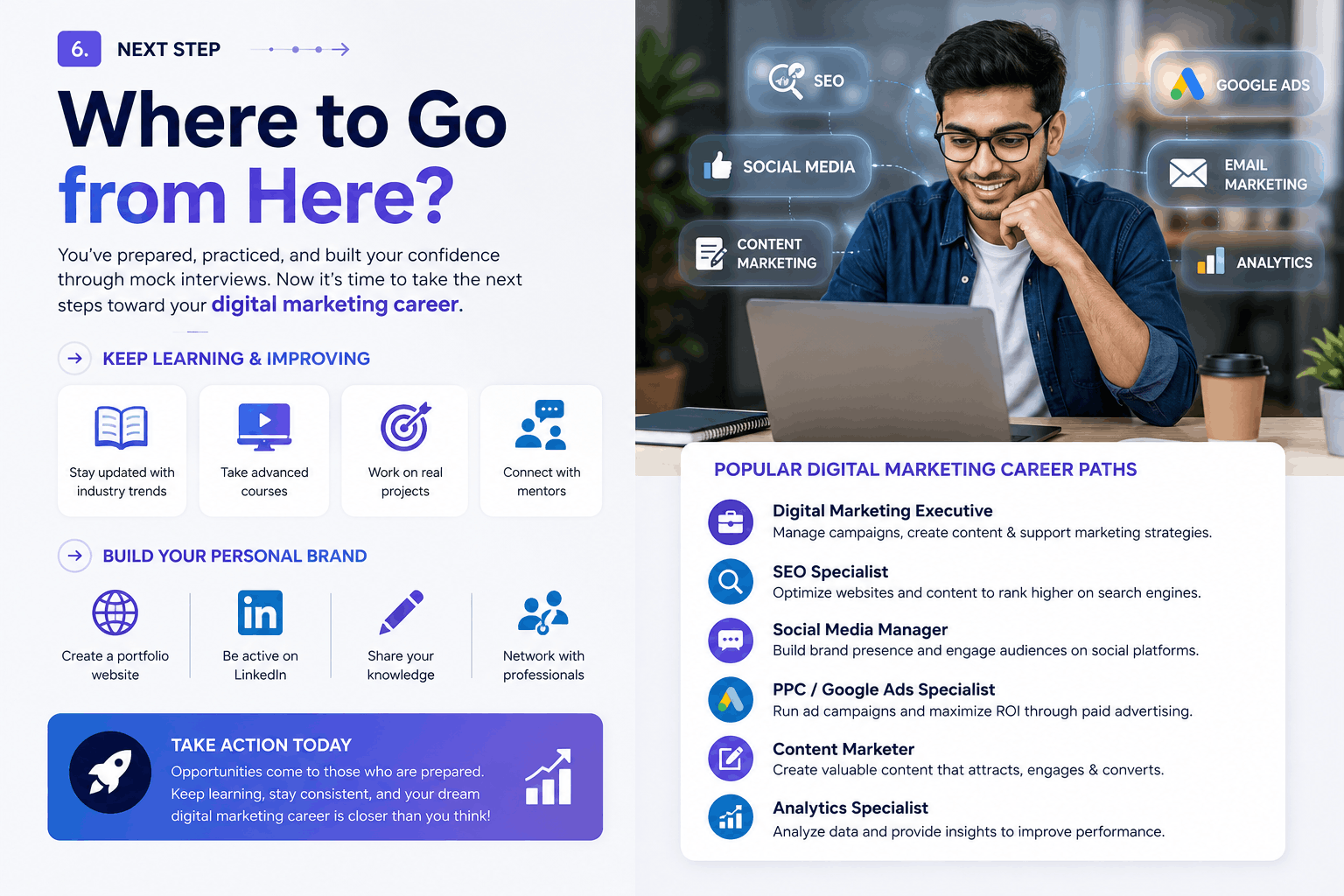
Digital Marketing Careers in India: What Freshers Should Know
If you’re preparing for a digital marketing mock interview in India, a few local realities are worth knowing before you walk in — interviewers often bring these up directly.
Internships Matter More Than You Think
Most Indian digital marketing companies value hands-on internship experience over just certifications. If you’ve done an internship — even an unpaid or short-term one — talk about the specific tasks you handled: content calendars, running small ad sets, keyword research, or reporting.
Fresher Salary Expectations
Entry-level digital marketing salaries in India vary widely depending on the city, company size, and role — typically ranging from a modest starting stipend at smaller agencies to a more competitive package at larger companies or MNCs. Rather than quoting a fixed number, be ready to say you’re open to discussing compensation based on the role and learning opportunity.
Agency vs In-House: Know the Difference
Interviewers often ask whether you’d prefer working at a digital marketing agency or in-house for a single brand. Have a genuine opinion ready:
- Agencies expose you to multiple clients and industries quickly, which is great for building a broad skill set early on.
- In-house roles let you go deep into one brand’s strategy and see long-term results of your work.
Neither answer is “wrong” — interviewers just want to see you’ve thought about it.
Tools You Should Be Comfortable Naming
Even as a fresher, mentioning familiarity with commonly used tools can make you stand out:
- Google Analytics and Google Search Console
- Google Ads and Meta Ads Manager
- WordPress (for basic website/CMS understanding)
- SEO tools like Ubersuggest, SEMrush, or Google Keyword Planner
- Canva for basic creative work
You don’t need expert-level mastery — just enough working knowledge to speak confidently if asked.
Talk About Local Business Marketing
Many Indian digital marketing roles, especially at agencies, involve working with small and local businesses. Being able to talk through how you’d market a neighbourhood store, a local clinic, or a small D2C brand on a limited budget shows practical thinking that interviewers genuinely value.
Frequently Asked Questions (FAQs)
1. How many mock interviews should I do before a real digital marketing interview?
There’s no fixed number, but 3–5 rounds are usually enough to feel noticeably more confident and identify most of your weak areas.
2. Do I need to know coding for a digital marketing interview?
No, coding isn’t mandatory for most digital marketing roles. However, basic familiarity with HTML or CMS platforms like WordPress can be a nice bonus, especially for SEO-focused roles.
3. What if I don’t have real work experience to talk about?
That’s completely normal for freshers. Talk about coursework projects, personal experiments (like running a sample campaign or blog), or case studies you’ve studied. Interviewers understand freshers are still building experience.
4. Should I prepare different answers for different companies?
Not entirely different, but you should tailor your examples and enthusiasm based on the company’s industry, size, and the specific role you’re applying for.
5. What’s the biggest mistake freshers make in digital marketing interviews?
Giving textbook definitions without practical understanding. Interviewers want to see that you can apply concepts, not just recite them.
6. Is it normal to feel nervous even after doing mock interviews?
Yes, a little nervousness is completely normal — even experienced professionals feel it. The goal of mock interviews isn’t to eliminate nerves completely, but to make sure they don’t derail your answers.
7. Where can I find a digital marketing mock interview to practice with?
Many training institutes and course providers offer structured digital marketing mock interview sessions as part of their placement support. You can also arrange one informally with a mentor, senior professional, or trainer — the key is finding someone who can ask realistic questions and give honest feedback.
Final Thoughts
A digital marketing mock interview isn’t just a formality you tick off your prep checklist — it’s genuinely one of the most effective ways to prepare for the real thing. It forces you to move your knowledge from “I understand this in theory” to “I can explain and apply this confidently under pressure.”
The freshers who walk into interviews and perform well aren’t necessarily the ones who know the most. They’re usually the ones who’ve practiced the most — out loud, under realistic conditions, with honest feedback.
So before your next digital marketing interview, don’t just revise your notes one more time. Sit down, simulate the real thing, get feedback, and refine your answers. That single habit could be the difference between an average interview and one that gets you the offer
REFERNCE LINK – https://www.google.com/business/