
Government vs private job in Haryana — this is one of the most common career dilemmas among students and job seekers across the state today, and with good reason. Haryana offers strong opportunities on both sides: a competitive government exam culture through HSSC and HCS, and a booming private sector centered around Gurugram, home to hundreds of MNCs and Fortune 500 offices.
So which path is actually right for you? This guide breaks down the real, data-backed differences — job security, salary, growth, and lifestyle — so you can decide with facts, not just family opinions.
Let’s get into it.
Why the Government vs Private Job Debate Matters So Much in Haryana
Haryana has a genuinely unique position in this conversation, and recent numbers make that clear.
According to the Periodic Labour Force Survey (PLFS) 2025, Haryana’s overall unemployment rate stood at 6.2% (July–September 2025), higher than the national average of 5.2–5.3% during the same period. The Economic Survey 2025-26 puts it at 5.7% for April–June and 6.2% for July–September. What’s more striking: unemployment among graduates in Haryana touches 14.1%, showing that a degree alone doesn’t guarantee a job anymore — the government-vs-private decision has real financial stakes.
At the same time, Gurugram alone hosts offices of 250 to 350+ Fortune 500 companies, out of more than 23,500 registered companies in the city, according to multiple industry reports. Gurugram alone contributes close to 60% of Haryana’s total revenue. So the private sector here isn’t a fallback option — it’s a genuine economic engine.
On the government side, competition is fierce but so is participation: the HSSC CET 2025 Group C exam saw around 13.48 lakh registered candidates, with roughly 8.12 lakh candidates qualifying — the highest pass percentage on record for the exam.
In short: this isn’t a choice between “something” and “nothing.” It’s a choice between two genuinely strong, well-populated paths — which is exactly why it deserves a proper, informed decision.
Government Job in Haryana: Core Advantages
Let’s start with what makes a government job in Haryana so attractive.
1. Job Security in Government Jobs
This is the biggest draw. Once you’re in, you’re in — barring serious misconduct, layoffs simply don’t happen the way they do in the private sector.
- No fear of sudden downsizing
- No dependency on company performance or market conditions
- Continues even during economic slowdowns or recessions
For families that have watched relatives struggle through job losses, this security is priceless. If you’re actively preparing, our HSSC CET Guide covers the exam pattern and syllabus in detail.
2. Structured Pay and Predictable Increments
Government salaries follow structured pay commissions, which means:
- Predictable annual increments
- Dearness Allowance (DA) that adjusts with inflation
- Transparent pay scales — no guessing games
You know roughly what you’ll earn in year 5, year 10, and year 20.
3. Pension and Retirement Benefits
While the old pension scheme has changed for many, government employees still enjoy:
- Structured retirement benefits (NPS contributions)
- Gratuity
- Provident fund support
This long-term financial cushion is something private-sector jobs rarely match.
4. Work-Life Balance in Government Roles
Government jobs are generally known for:
- Fixed working hours
- Weekly offs that are actually respected
- Lower pressure to constantly “prove yourself”
5. Social Respect and Local Value
In smaller cities and towns across Haryana, a government job still carries real social weight — easier loan approvals, more respect in the community, and often better marriage prospects too.
Private Job in Haryana: Core Advantages
Now let’s flip the coin and look at why a private job in Haryana — especially in Gurugram — is equally compelling.
1. Higher Earning Potential
This is where private jobs often win, especially in skilled, in-demand fields.
- Salaries in IT, finance, and management can significantly exceed equivalent government pay
- Performance bonuses, ESOPs, and incentives boost income further
- Gurugram-based MNCs like Google, Microsoft, Amazon, TCS, and EY offer packages that rival global standards
2. Faster Career Growth
Private companies often promote based on performance, not just seniority.
- You can move up quickly if you deliver results
- Skill-based growth means you’re not stuck waiting for a vacancy to open
- Job-hopping for better roles and pay is common and often encouraged
If digital and marketing roles interest you specifically, check out our Digital Marketing Career guide for scope and salary details.
3. Diverse Skill and Industry Exposure
Working in Haryana’s corporate hubs — especially Gurugram’s DLF Cyber City and Udyog Vihar corridors — exposes you to:
- Modern tools and technologies
- Cross-functional teams and global clients
- International work culture and practices
4. Flexibility and Innovation
Many private companies now offer:
- Hybrid or remote work options
- Flexible hours in certain roles
- A culture that rewards new ideas and initiative
5. Faster Entry Into the Workforce
Private-sector hiring is generally much faster than government recruitment.
- No lengthy exam cycles or waiting periods
- Campus placements can secure a job before graduation
- Multiple hiring rounds happen throughout the year, not just once
Government vs Private Job in Haryana: A Side-by-Side Comparison
| Factor | Government Job | Private Job |
|---|---|---|
| Job Security | Very High | Moderate to Low |
| Starting Salary | Moderate | Often Higher |
| Growth Speed | Slow, seniority-based | Fast, performance-based |
| Work Hours | Fixed, predictable | Can be demanding |
| Skill Exposure | Limited | High |
| Entry Process | Long (exams — 13.48 lakh+ applicants for HSSC CET 2025) | Comparatively faster |
| Retirement Benefits | Strong | Limited (self-managed) |
| Social Perception | High, especially in smaller towns | Growing rapidly, especially in Gurugram |
Quick Pros and Cons Summary
Government Job — Pros: job security, pension, fixed hours, social respect Government Job — Cons: slower growth, lower starting pay, long and competitive exam process
Private Job — Pros: higher pay potential, faster growth, skill exposure, quicker entry Private Job — Cons: less job security, longer/unpredictable hours, no guaranteed pension
Government vs Private Job in Haryana: Real Salary Examples
Numbers make this comparison far more useful than vague statements like “private pays more.” Here’s what specific roles actually pay, based on current 2025-26 data:
| Job Role | Sector | Approx. Monthly Salary (In-Hand) | Approx. Annual (LPA) |
|---|---|---|---|
| HSSC Clerk | Government | ₹26,400 – ₹28,500 | ₹3.2 – 3.4 LPA |
| Haryana Police Constable | Government | ₹30,000 – ₹38,000 | ₹3.6 – 4.5 LPA |
| Software Engineer (Gurugram, fresher) | Private | ₹35,000 – ₹65,000 | ₹4 – 8 LPA |
| Digital Marketing Executive (Gurugram) | Private | ₹20,000 – ₹35,000 | ₹2.5 – 4.2 LPA |
| Accountant (Gurugram, fresher) | Private | ₹18,000 – ₹28,000 | ₹2.2 – 3.4 LPA |
A few things stand out here:
- Entry-level government and private salaries are often closer than people assume — an HSSC Clerk and a fresher Accountant in Gurugram start in a fairly similar range.
- The real gap opens up with specialization. A software engineer with in-demand skills (React, Python, cloud) can move from ₹4-8 LPA as a fresher to ₹15-20+ LPA within a few years — a pace government pay scales simply aren’t built for.
- Government roles compound differently — through DA revisions, pension, and guaranteed promotions rather than sharp salary jumps.
(Note: These are approximate, role-specific ranges based on current government pay matrices and industry salary data. Actual pay varies by department, company, experience, and city of posting.)

Government vs Private Job in Haryana: Which One Should You Choose?
There’s no universal right answer. Ask yourself these questions instead.
What’s your risk appetite?
If sudden job loss or income uncertainty stresses you out, government roles offer peace of mind. If you’re comfortable with some risk for higher reward, a private job may suit you better.
What are your long-term goals?
Want a stable, predictable routine? Government jobs deliver that. Want rapid growth, higher income, and constant learning? Private jobs are built for that.
What’s your field of interest?
Some fields — teaching, administration, defence, public sector banking — naturally lean government. Others — IT, digital marketing, product management, consulting — are dominated by the private sector.
How do you handle competition?
Government exams involve intense, prolonged competition. With over 13 lakh candidates competing for HSSC CET Group C posts alone in 2025, patience and consistent preparation are non-negotiable. If years of preparation don’t suit you, the private route can get you working — and earning — much sooner.
Government vs Private Job in Haryana: Final Recommendation by Student Profile
Since the right choice often depends on your academic background, here’s a quick, practical guide:
- Engineering students: Private jobs (especially in Gurugram’s IT and core engineering firms) usually offer faster growth and higher starting packages. Government PSU exams (like SSC JE, RRB) remain a strong backup for stability-focused engineers.
- Commerce students: Both paths work well — private roles in finance, accounting, and banking offer quick entry and growth, while government banking exams (IBPS, SBI) and HCS offer long-term security.
- Arts and humanities students: Government exams (HCS, teaching, administrative services) tend to align naturally with these backgrounds. However, private-sector roles in content, HR, marketing, and communications in Gurugram are growing fast and worth exploring. If you’re still exploring options broadly, our Career Guidance for Class 12 Students is a good starting point.
- Science students (non-engineering): Government roles in research, healthcare, and education offer stability, while private labs, healthcare chains, and ed-tech companies offer quicker entry and skill-based growth.
A Balanced Approach: You Don’t Have to Choose Forever
This isn’t a lifetime decision made at 21.
- Many people start in private jobs to gain experience and financial stability, then prepare for government exams later.
- Others start with a government job for security, then explore private opportunities once they’ve built confidence and savings.
- Some professionals — especially in teaching or engineering — successfully combine both paths at different life stages.
Stop thinking of this as all-or-nothing. Think of it as a stage-appropriate choice based on where you are in life right now.
Tips for Haryana Students Trying to Decide
- Talk to people actually working in both sectors — real experiences matter more than assumptions.
- Consider your subject strengths. Strong in current affairs, reasoning, and general studies? Government exams may suit you. Technically skilled or good with people? Private roles might fit better.
- Don’t ignore financial pressure at home. If your family needs income soon, don’t spend years preparing for exams without a backup plan.
- Keep upskilling regardless of the path. Government employees benefit from digital skills too, and private employees need to stay updated constantly.
- Check official sources before deciding. Visit the HSSC official website for exam notifications, or the National Career Service portal run by the Ministry of Labour & Employment, Government of India, for verified job listings across both sectors.
Related Reads
- Government Jobs in Haryana: Complete List and Eligibility
- HSSC CET Guide: Syllabus, Pattern, and Preparation Tips
- Career Guidance for Class 12 Students in Haryana
- Digital Marketing Career: Scope and Salary in India
(Link these to your existing articles on the site for stronger internal linking and SEO value.)

Conclusion
The government vs private job debate in Haryana isn’t about which one is “better” in some universal sense — it’s about which one is better for you, based on your goals, risk tolerance, and the kind of life you want to build.
Government jobs offer security, structure, and long-term stability — a solid choice if peace of mind matters most. Private jobs offer speed, higher earning potential, and constant growth — ideal if you’re driven, adaptable, and ready for calculated risks.
The good news? Haryana gives you strong opportunities on both fronts. So instead of chasing what everyone else calls “safe” or “better,” understand your own strengths and choose the path that aligns with the life you actually want to live.
Still confused about which path fits you? Explore our HSSC CET Guide if you’re leaning government, or check out our Career Guidance resources to map out your options in more detail.
Government vs Private Job in Haryana: Frequently Asked Questions (FAQs)
1. Which is better, government or private job, for students in Haryana?
It depends on your priorities. Government jobs offer stability and work-life balance, while private jobs offer faster growth and higher earning potential, especially in cities like Gurugram.
2. Are government job salaries lower than private job salaries in Haryana?
Not always. Entry-level government salaries can be competitive, but private-sector salaries — especially in skilled fields like IT — often grow faster and can exceed government pay over time.
3. Is it possible to switch from a private job to a government job later?
Yes. Many professionals work in the private sector first and prepare for government exams alongside or after gaining work experience, as long as they meet age eligibility criteria.
4. Which government exams are popular among students in Haryana?
HSSC CET, HCS (Haryana Civil Services), various police and teaching recruitment exams, and central-level exams like SSC and banking exams are commonly attempted by students from Haryana.
5. Do private jobs in Haryana offer good career growth?
Yes, particularly in Gurugram, which hosts offices of over 250 Fortune 500 companies and thousands of MNCs and startups, offering rapid promotions and skill-based growth opportunities.
6. What is the current unemployment rate in Haryana?
As per PLFS 2025 data, Haryana’s unemployment rate stood at around 6.2%, higher than the national average of 5.2–5.3% for the same period, with graduate unemployment at 14.1%.
7. What matters more — job security or salary?
This is a personal choice. If financial predictability and long-term stability matter most, prioritize security. If you’re comfortable with some risk for potentially higher rewards, prioritize salary and growth.
Suggested Visuals for This Article
-
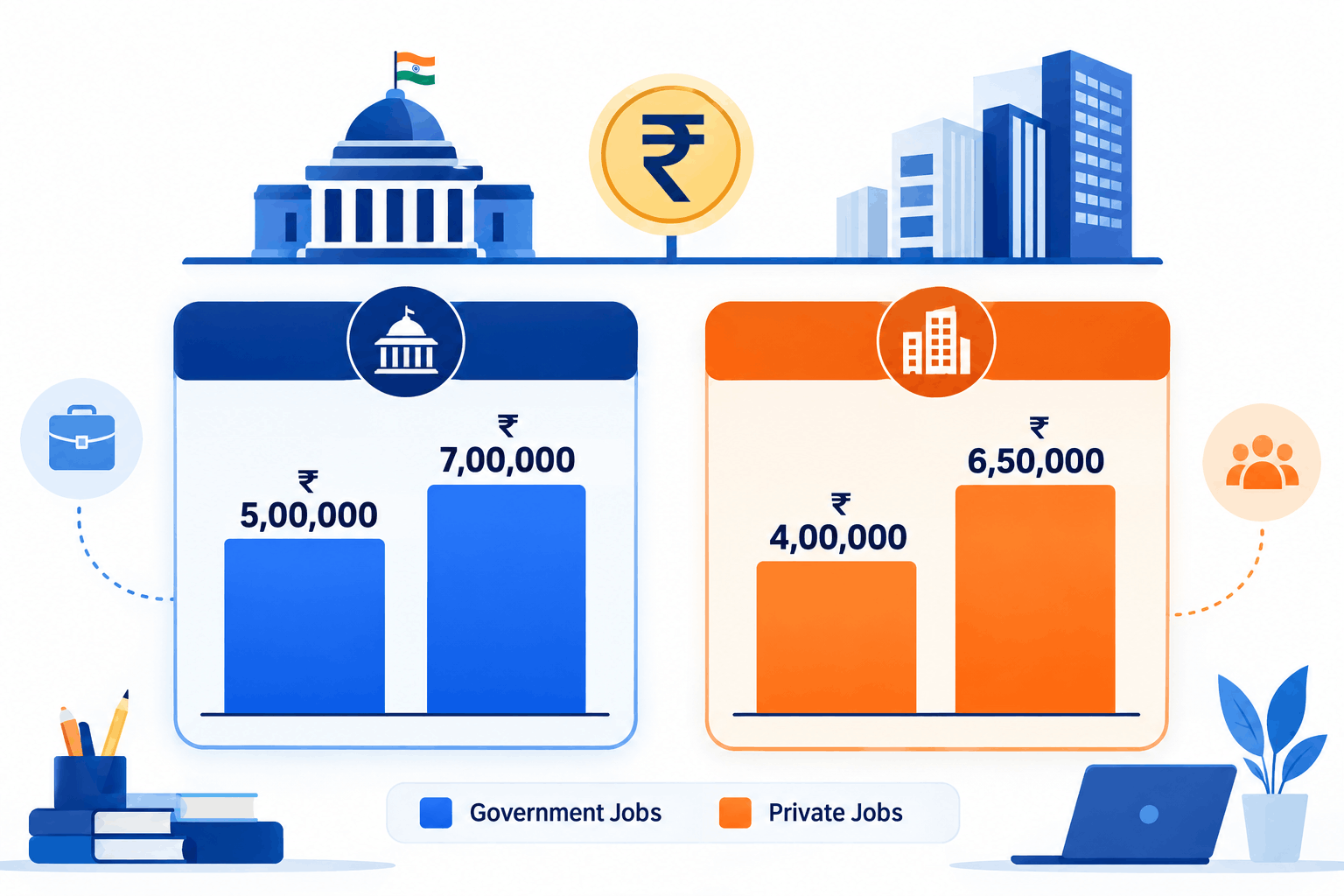
- Role-wise salary comparison chart — Bar chart comparing HSSC Clerk, Police Constable, Software Engineer, Digital Marketing Executive, and Accountant salaries side by side (Alt text: “government vs private job salary comparison by role Haryana chart”)
- Salary comparison infographic — Government vs Private average starting salaries in Haryana by sector (Alt text: “government vs private job salary comparison Haryana infographic”)
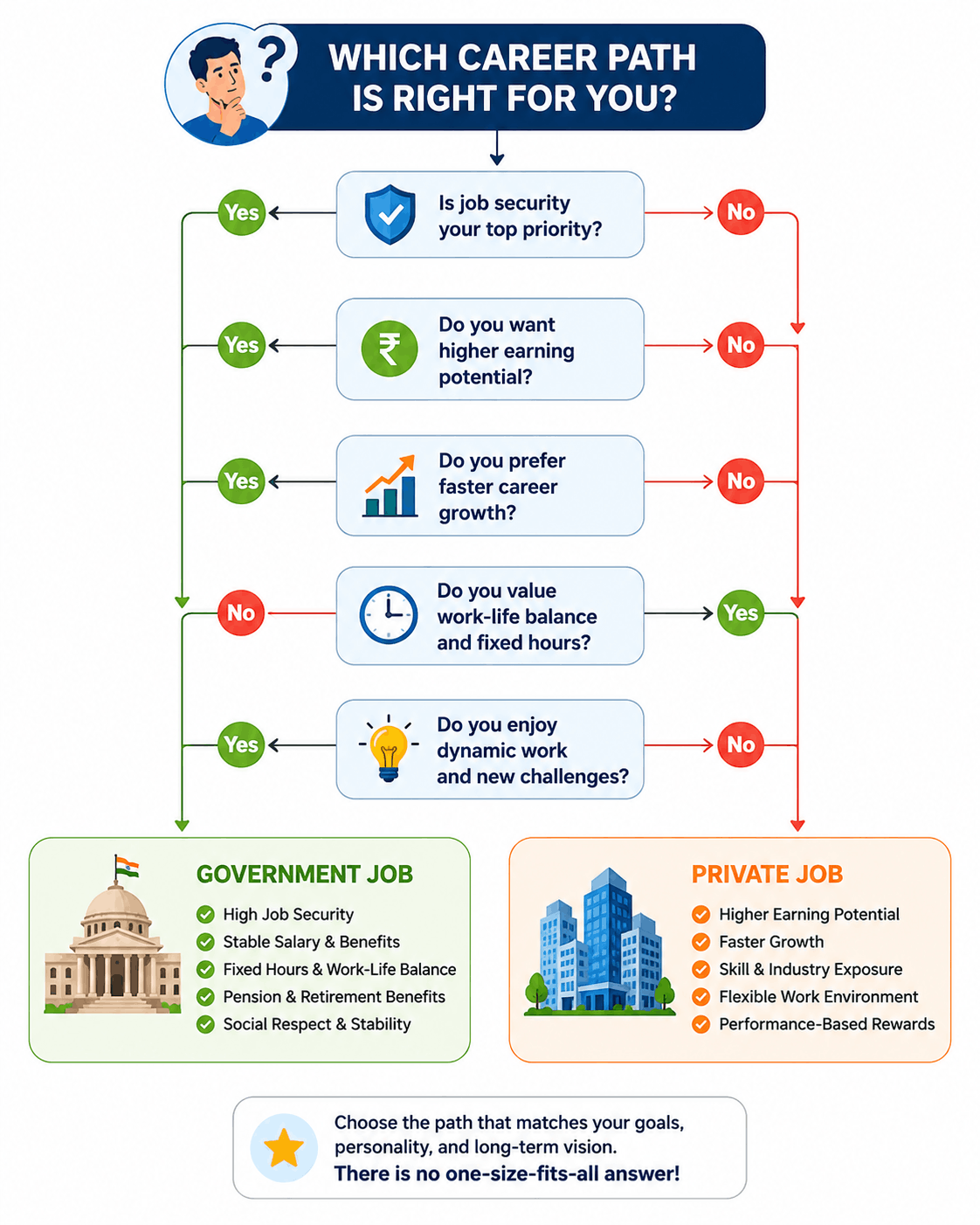
- Career decision flowchart — A simple yes/no flowchart helping readers decide based on risk appetite and goals (Alt text: “career decision flowchart government or private job”)
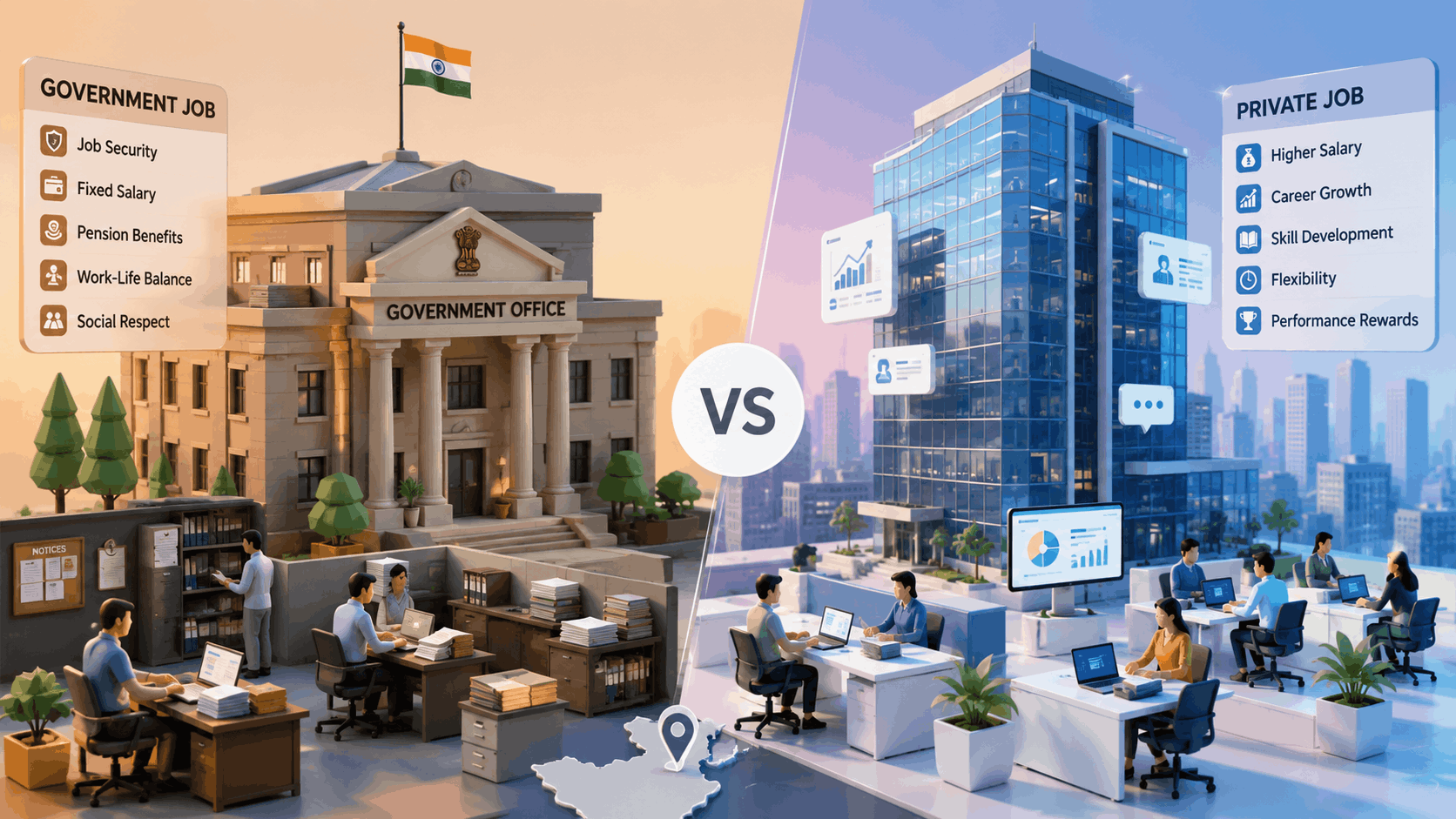
- Haryana government vs private sector illustration — Side-by-side visual of a government office and a Gurugram corporate office (Alt text: “Haryana government job vs private job illustration”)
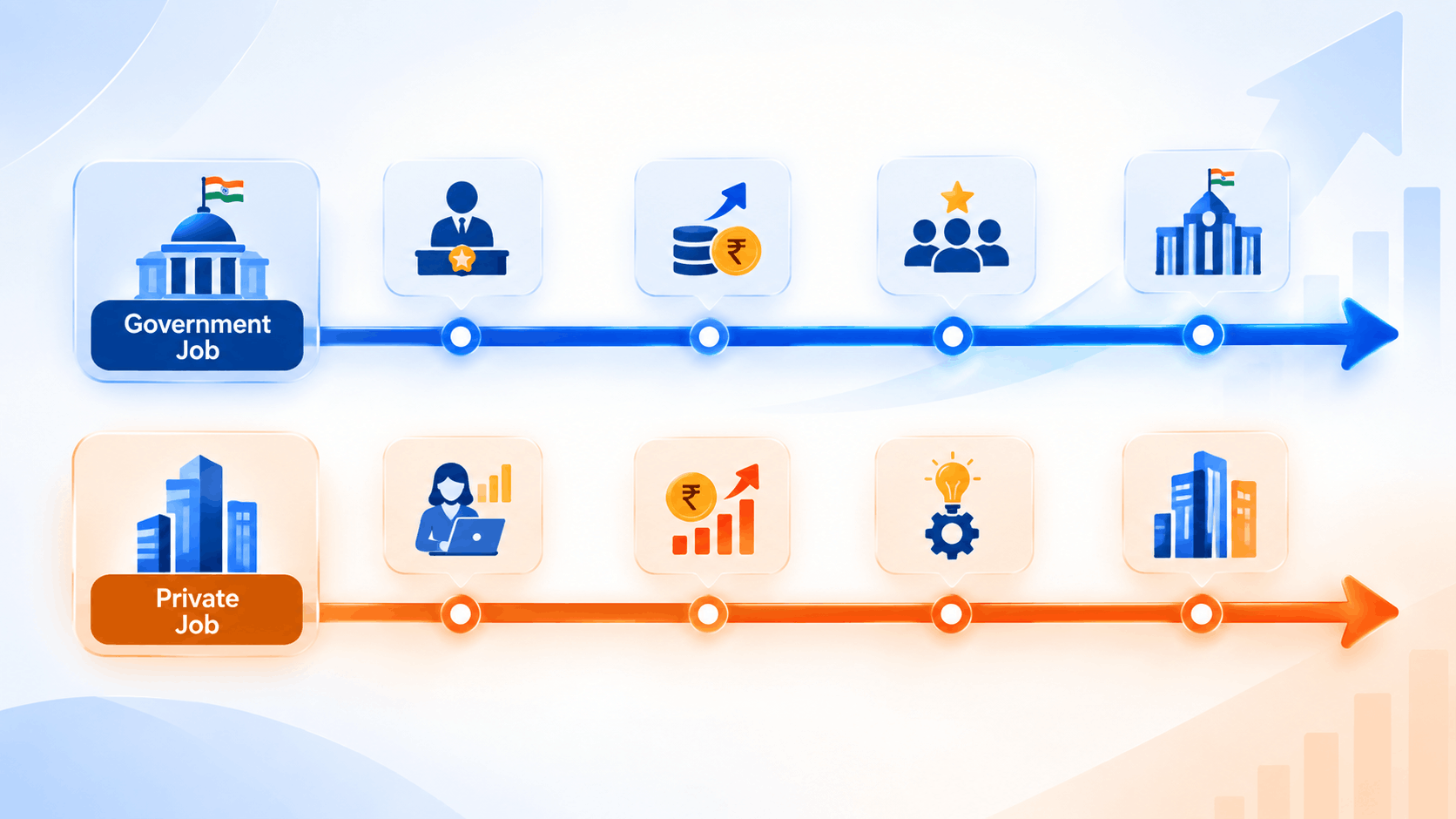
- Timeline of career growth — Visual showing typical promotion timelines in government vs private roles over 10–15 years (Alt text: “government vs private job career growth timeline Haryana”)
Haryana Staff Selection Commission (HSSC) — Official Website