
If financial constraints have ever made you hesitate before choosing a college or course, the Dr. Ambedkar Scholarship 2026 is exactly the kind of support worth knowing about
Named after Dr. Bhimrao Ramji Ambedkar — the architect of the Indian Constitution and a lifelong advocate for education among marginalised communities — this scholarship exists in multiple forms across India, run both as a central government scheme and through several state-specific programs. That’s actually where most of the confusion comes from: search “Dr. Ambedkar Scholarship” online, and you’ll find wildly different eligibility criteria and amounts depending on which state or scheme you’re looking at.
This guide clears up that confusion, walking you through exactly what the Dr. Ambedkar Scholarship 2026 covers, who qualifies, how much you can expect, and how to actually apply — for both the central scheme and major state-level variants.
Quick Comparison: Dr. Ambedkar Scholarship Schemes at a Glance
| Scheme | Who It’s For | Approx. Amount | Income Limit |
|---|---|---|---|
| Central (DNT Scheme) | DNT students not covered under SC/ST/OBC | ₹1,200-1,500/year | ₹2 lakh |
| Haryana | SC, Backward Classes, DNT/Nomadic communities | ₹8,000-12,000/year | ~₹4 lakh (reported, verify current limit) |
| Punjab | SC students, Class 11 to PhD | Full tuition + ₹230-1,200/month | Varies by scheme component |
| Chandigarh | EBC students | Freeship card (fee waiver) | Varies by scheme component |
Note: This table is a quick-reference summary only. Exact amounts, income limits, and eligibility details should always be confirmed against the current official 2026-27 notification for your specific state and scheme before applying — figures above reflect the most recent publicly available information at the time of writing.
Understanding the Dr. Ambedkar Scholarship 2026: Central vs State Schemes
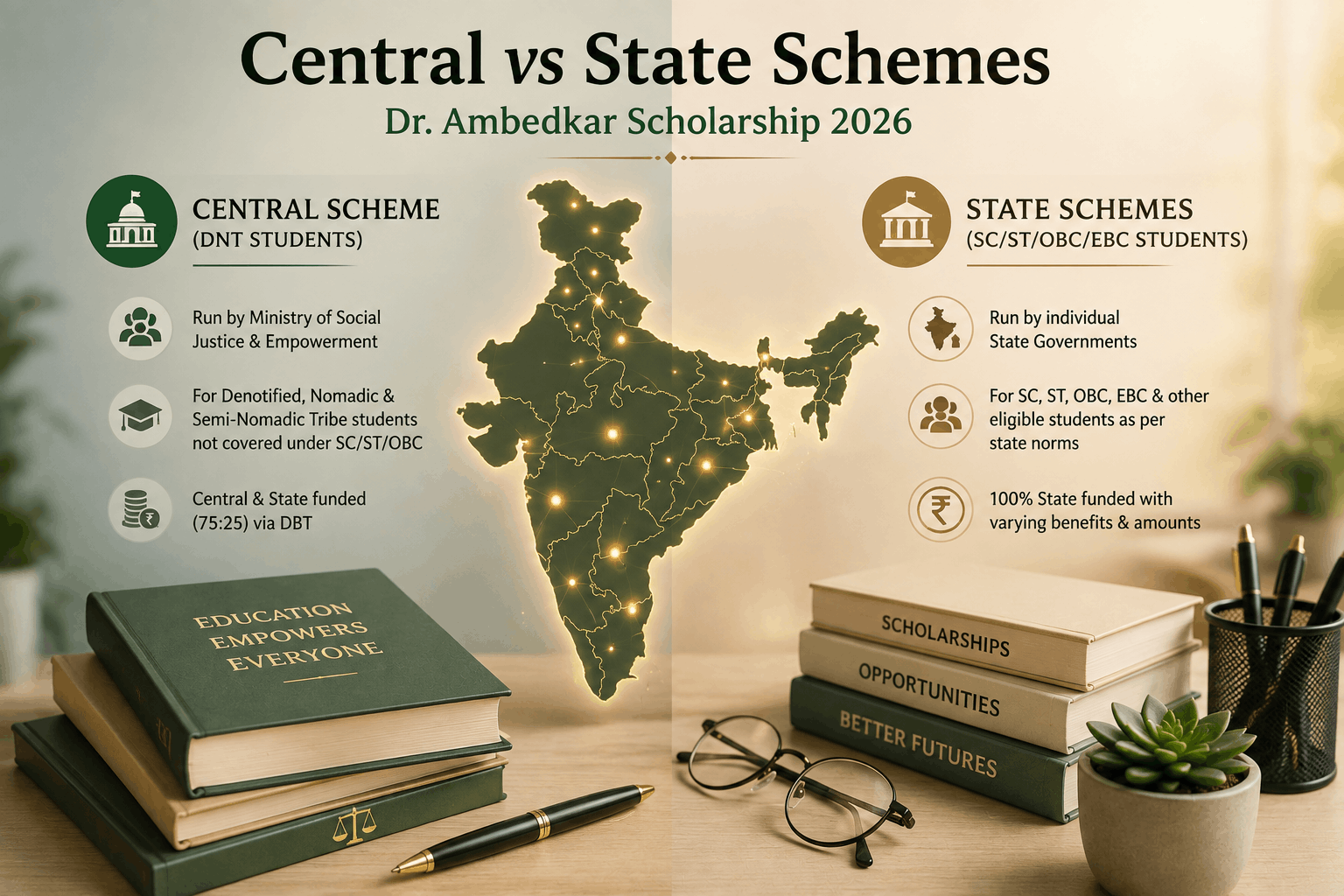
Before diving into specifics, here’s the single most important thing to understand about the Dr. Ambedkar Scholarship 2026: it isn’t one single scheme.
- The central government scheme, run by the Ministry of Social Justice and Empowerment, specifically supports Denotified, Nomadic, and Semi-Nomadic Tribe (DNT) students who don’t fall under existing SC, ST, or OBC reserved categories
- Several state governments run their own, separately funded Dr. Ambedkar-named scholarships, typically for SC, ST, OBC, or Economically Backward Class (EBC) students, with eligibility criteria and amounts that vary significantly by state
- Both types are generally administered through the National Scholarship Portal (NSP), though some states also maintain their own dedicated portals alongside NSP
Knowing which version applies to you is the first step, since applying to the wrong scheme wastes time and often leads to automatic rejection.
Dr. Ambedkar Scholarship 2026: Central Scheme (For DNT Students)
This is the scheme run directly by the central government, officially named the Dr. Ambedkar Pre and Post-Matric Scholarship Scheme for DNTs, administered by the Department of Social Justice and Empowerment. Full scheme guidelines are published on the official Department of Social Justice and Empowerment website.
Eligibility for the Central Dr. Ambedkar Scholarship
- The applicant must belong to a Denotified, Nomadic, or Semi-Nomadic Tribe not already covered under SC, ST, or OBC categories
- Annual family income from all sources must not exceed ₹2 lakh
- Applicants should be studying anywhere from Class 1 through Class 12 for the pre-matric component, or pursuing post-matric and higher education (including graduation, postgraduation, M.Phil, PhD, and post-doctoral programmes) for the post-matric component
Dr. Ambedkar Scholarship Amount (Central Scheme)
- Pre-matric students: Up to ₹1,500 per year
- Post-matric students: Up to ₹1,200 per year
The scheme has been running since 2014-15, with funding split 75% by the Centre and 25% by the respective State, disbursed directly through Direct Benefit Transfer (DBT) into the student’s bank account.
Dr. Ambedkar Scholarship 2026: State-Specific Schemes
This is where the Dr. Ambedkar Scholarship 2026 looks dramatically different depending on where you live. Here’s a breakdown of two major state examples.
Haryana: Dr. Ambedkar Scholarship for SC and Backward Class Students
Haryana’s version of this scholarship — officially known as the Dr. Ambedkar Modified Medhavi Chhattar Yojana, administered through the state’s Welfare of Scheduled Castes & Backward Classes Department — offers considerably higher amounts than the central DNT scheme, and covers a broader student base, including Backward Classes, Scheduled Castes, and Denotified/Nomadic/Semi-Nomadic communities, from Class 11 through postgraduate level. Reported eligibility criteria include a family income limit of up to ₹4 lakh, though this should be confirmed against the current official notification, since income thresholds are periodically revised.
Dr. Ambedkar Scholarship Amount (Haryana, for SC students):
| Course Level | Amount (₹/year) |
|---|---|
| Class 11 / first year of Diploma-Certificate courses | ₹8,000 |
| First year graduation (Arts/Commerce/Science) | ₹8,000 |
| First year graduation (Engineering/Technical) | ₹9,000 |
| First year graduation (Medical and allied) | ₹10,000 |
| First year postgraduation (Arts/Commerce/Science) | ₹8,000 |
| First year postgraduation (Engineering/Technical) | ₹9,000 |
| First year postgraduation (Medical and allied) | ₹12,000 |
Backward Classes (Block A) students are eligible for similar amounts under a parallel track of the same scheme. For more details specific to Haryana’s scheme, the Welfare of Scheduled Castes & Backward Classes Department, Haryana is the official source to check.
Punjab: Dr. B.R. Ambedkar Post-Matric Scholarship
Punjab runs one of the most comprehensive versions of this scholarship, covering full tuition fees plus a monthly maintenance allowance for SC students, from Class 11 all the way through PhD level.
- Covers professional courses like engineering, medicine, law, MBA, and MCA, alongside general degree programs
- Maintenance allowance ranges from ₹230 to ₹1,200 per month, depending on the course and whether the student is a day scholar or hosteller
- Income limits vary by scheme component, with different reported figures for SC and BC categories — confirm the current applicable limit for your specific category on the official portal before applying
- Also includes support for non-refundable fees, thesis work, and study tours for eligible postgraduate and research students
- Administered through the Punjab Department of Welfare of Scheduled Castes and Backward Classes; current notifications are available on the Dr. Ambedkar Scholarship Portal Punjab
Chandigarh: Dr. Ambedkar Post-Matric Scholarship for EBC Students
Chandigarh’s version specifically targets Economically Backward Class (EBC) students, offering a freeship card that allows admission without pre-payment of tuition and hostel fees, administered by the Chandigarh Administration under the Ministry of Social Justice and Empowerment’s centrally sponsored framework.
How to Apply for the Dr. Ambedkar Scholarship 2026
Since 2026, the application process has moved toward being fully digital and Aadhaar-authenticated for schemes routed through the National Scholarship Portal, which genuinely simplifies things compared to previous years — though exact requirements can still vary slightly for state-specific schemes using their own separate portals.
Step-by-Step Application Process
- Complete One-Time Registration (OTR) on the National Scholarship Portal, using your Aadhaar number — this is required for schemes routed through NSP, though states with their own separate portals may have a different registration step
- Select the correct scheme for your category and state — this is the step where students most often make mistakes, so double-check whether you qualify for the central DNT scheme or your specific state’s version
- Fill in your academic and personal details, including your current course, institution, and family income
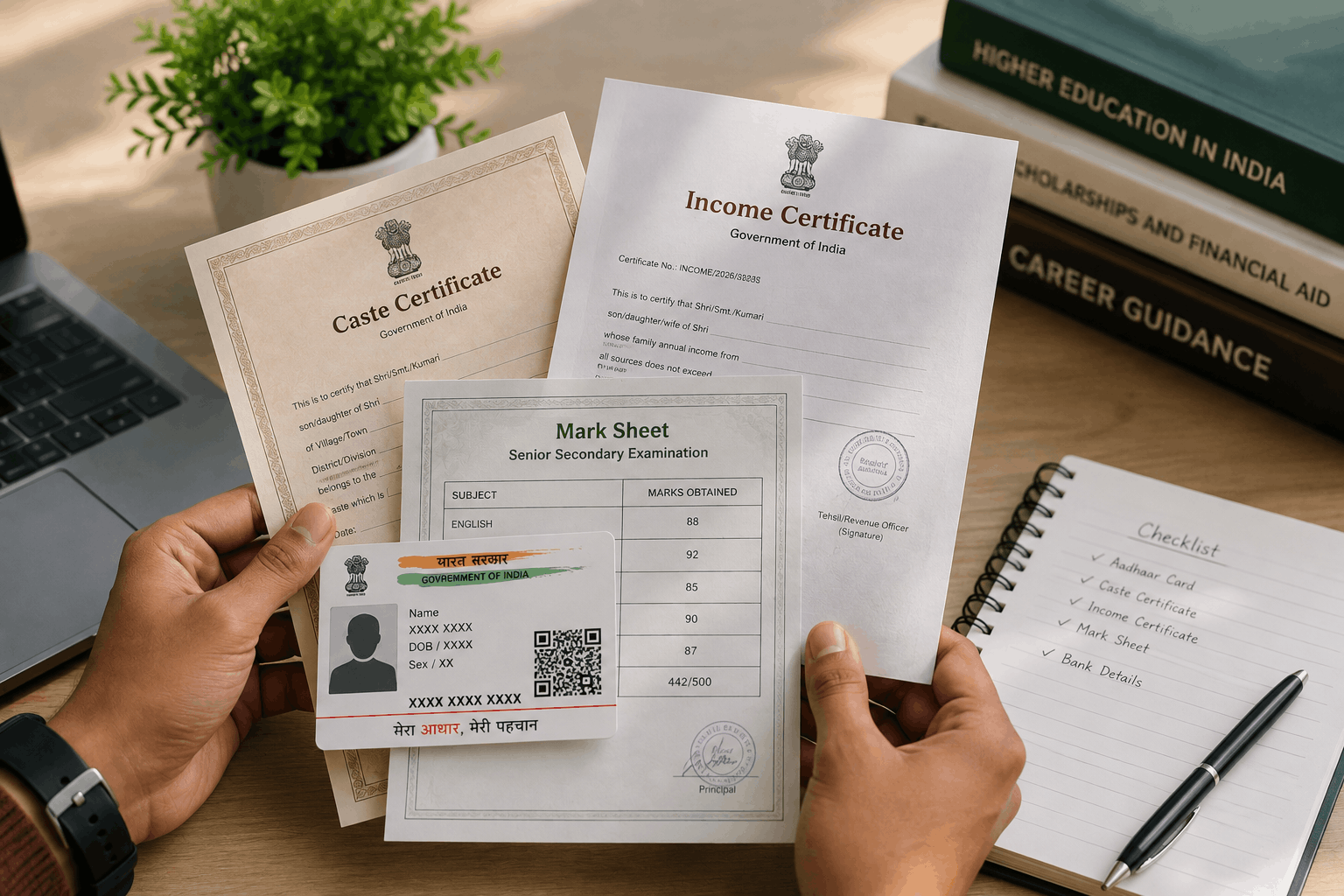
- Upload required documents, including your caste/category certificate, income certificate, previous academic mark sheets, and bank account details
- Submit your application and track its status through the NSP portal or your state’s dedicated scholarship portal, where applicable
- Verification and disbursement: Once your application is verified by your institution and the relevant department, the scholarship amount is disbursed directly to your bank account via DBT
Documents You’ll Typically Need
- Aadhaar card
- Caste/category certificate confirming DNT, SC, ST, OBC, or EBC status, as applicable
- Income certificate confirming your family falls within the eligibility limit
- Previous year’s mark sheet or admission proof for the current academic year
- Bank account details linked to Aadhaar, for DBT disbursement
Dr. Ambedkar Scholarship 2026: Important Dates to Know
Application windows vary by state and scheme, so treat these as general patterns rather than fixed dates for every version:
- Central scheme applications typically follow the broader NSP registration and application cycle
- For the 2025-26 cycle, Punjab’s scheme deadline reportedly extended into February 2026, with some scheme components open until March — but this is last cycle’s timeline, not a confirmed 2026-27 date
- Haryana’s portal has similarly accepted applications into the early months of the year in past cycles
Important caveat: The specific dates above reflect the previous (2025-26) application cycle based on available reporting at the time of writing, not confirmed dates for the 2026-27 cycle. Since these dates shift each academic year and by state, always confirm the exact current deadline for your specific scheme directly on the National Scholarship Portal or your state’s official scholarship department website, rather than relying on this or any other article’s estimate.
Common Mistakes Students Make While Applying
Mistake 1: Applying to the Wrong Version of the Scheme
Since the central DNT scheme and various state schemes have completely different eligibility criteria, students sometimes apply to the wrong one — for example, an SC student in Haryana mistakenly applying under the central DNT-only scheme, which they wouldn’t qualify for.
Mistake 2: Missing the One-Time Registration Step
Since OTR on the National Scholarship Portal is required for NSP-routed schemes, skipping this step or completing it incorrectly can delay or block your application if your specific scheme uses NSP.
Mistake 3: Submitting Mismatched or Outdated Documents
Category and income certificates that don’t match your current application details, or documents that have expired, are among the most common reasons applications get stuck in verification.
Mistake 4: Waiting Until the Deadline to Apply
Given how state-specific deadlines can shift and how document verification takes time, applying well before the deadline gives you room to fix any issues that come up during processing.
Why Understanding Your Specific Scheme Matters So Much
It’s worth repeating this point, since it’s genuinely the biggest source of confusion around the Dr. Ambedkar Scholarship 2026: the name alone doesn’t tell you what you’re eligible for.
- A DNT student in Maharashtra and an SC student in Haryana could both be searching “Dr. Ambedkar Scholarship 2026” and land on completely different schemes, with different portals, different documents, and different amounts
- Some states may not run a distinct Dr. Ambedkar-named scheme at all, instead folding similar support into broader post-matric scholarship programs for SC/ST/OBC students
- Even within a single state, the scheme can change year to year in terms of eligibility thresholds, amounts, or which department administers it
The safest approach is always to start from your state’s official welfare or social justice department website, or the National Scholarship Portal directly, rather than relying on generic search results or outdated blog posts (including, to be fair, parts of this one, since these figures can be revised). Treat this guide as a starting framework for understanding how the scheme generally works, and always confirm the exact current details for your specific state and category before applying.
How This Fits Into Your Broader Scholarship Search
The Dr. Ambedkar Scholarship 2026 is just one of several government scholarship options available to Indian students. If you’re exploring your options more broadly, our Top Scholarships for Indian Students guide covers other central and private scholarship programs worth considering alongside this one. And if you’re specifically in Haryana and also exploring region-specific support, our Naveen Jindal Yashasvi Scholarship 2026 guide covers another Haryana-focused option that might be worth applying to in parallel.
Frequently Asked Questions About Dr. Ambedkar Scholarship 2026
1. Who is eligible for the Dr. Ambedkar Scholarship 2026?
It depends on the specific scheme. The central scheme covers Denotified, Nomadic, and Semi-Nomadic Tribe (DNT) students not covered under SC/ST/OBC, with family income under ₹2 lakh. State-specific schemes, like those in Haryana and Punjab, cover SC, Backward Class, or EBC students with their own separate eligibility criteria.
2. How much is the Dr. Ambedkar Scholarship amount in 2026?
Amounts vary significantly. The central DNT scheme offers ₹1,500/year (pre-matric) and ₹1,200/year (post-matric). Haryana’s scheme offers ₹8,000-12,000 depending on course level, while Punjab’s scheme covers full tuition plus a monthly maintenance allowance of ₹230-1,200.
3. How do I apply for the Dr. Ambedkar Scholarship 2026?
Most applications go through the National Scholarship Portal (scholarships.gov.in), starting with a One-Time Registration using Aadhaar for NSP-routed schemes, followed by selecting your specific scheme, filling in details, and uploading required documents. Some state schemes with separate portals may follow a slightly different first step.
4. Is the Dr. Ambedkar Scholarship the same across all states?
No. While some central components exist, most versions of this scholarship are state-specific, with different eligibility criteria, amounts, and application portals depending on where you live.
5. What documents are required for the Dr. Ambedkar Scholarship application?
Typically an Aadhaar card, caste/category certificate, income certificate, previous academic mark sheets, and bank account details linked to Aadhaar for Direct Benefit Transfer.
6. Can OBC students apply for the Dr. Ambedkar Scholarship?
It depends on the state. Some state-specific schemes include OBC students, while the central DNT scheme specifically excludes students already covered under SC, ST, or OBC categories. Check your specific state’s scheme details to confirm.
7. When is the last date to apply for Dr. Ambedkar Scholarship 2026?
Deadlines vary by state and scheme, and have historically ranged from October-November for some central components to February-March for certain state schemes. Always verify the current deadline directly on the National Scholarship Portal or your state’s official scholarship website.
Final Thoughts on Dr. Ambedkar Scholarship 2026
The Dr. Ambedkar Scholarship 2026 genuinely offers meaningful financial support, but only if you apply to the correct version for your category and state. Before you start your application, take a few minutes to confirm exactly which scheme — central or state-specific — actually applies to you, since this single step prevents most of the common application mistakes students make.
https://www.buddy4study.com/article/dr-ambedkar-scholarship-for-pre-and-post-matric-students