
So, you want to study abroad Australia? That is an amazing goal! Australia is famous for its world-class universities, sunny beaches, and relaxed lifestyle. But before you can pack your bags, you have to prove you can understand and learn in English.
You do this by taking an English test. The most popular tests areIELTS Academic and PTE Academic.
In this guide, we’re breaking it all down in plain, simple language. No jargon, no confusing university lingo — just what you need to know to make your Australian study dream a reality in 2026.

Why Study Abroad Australia Is a Smart Choice
Studying abroad in Australia is a smart choice. You get a world-class education with globally recognized degrees, right to work part-time while studying, and post-study work visas to kick-start your career. It is a safe, sunny, and welcoming English-speaking country.
- Top-Tier Education: Australia is home to several universities ranked in the global top 50. You get a high-quality education that employers around the world respect.
- Work While You Learn: You can work part-time while you study. This helps pay for living costs and builds your resume.
- Post-Study Work Visas: Australia lets you stay and work after you finish your degree. Depending on your course, you can work for two to six years. This is a great way to start your global career.
- Easy Visa and Support: The student visa process is clear and straightforward. Also, all international students are required to have Overseas Student Health Cover (OSHC), which makes accessing doctors easy and affordable.
- Safe and Welcoming Lifestyle: Australia is very safe and culturally diverse. It blends top academics with a relaxed, outdoor lifestyle. You can explore beautiful beaches on the weekends.
Understanding “Good Score” — It’s Not Just One Number
When people search for study abroad Australia, one of the most common follow-up questions is: “What’s a good score to get in?”
Here’s the truth — there isn’t a single magic number. A “good score” depends on three separate things:
- Your English proficiency test score (IELTS, PTE, TOEFL, etc.)
- Your academic score (high school or bachelor’s GPA/percentage)
- The specific requirements of the university and course you’re applying to
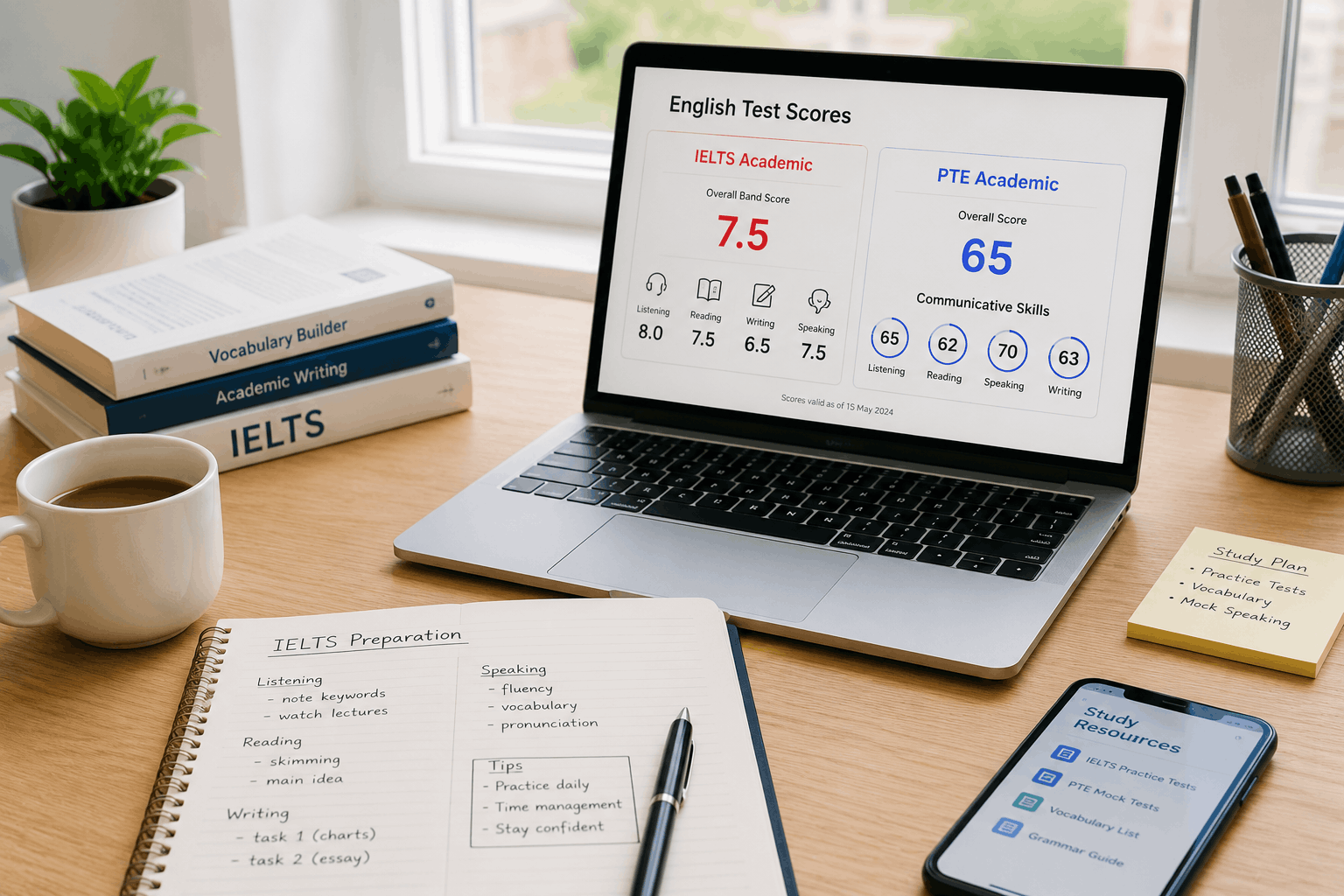
1. English Proficiency Scores That Universities Actually Accept
Most Australian universities require proof of English proficiency unless you’ve studied in an English-medium institution before. Here’s a general benchmark for 2026:
IELTS Academic
- Minimum acceptable: 6.0 overall (with no band below 5.5)
- Good score for top universities: 6.5–7.0 overall
- Competitive courses (Medicine, Law, Journalism): 7.5+ overall
PTE Academic
- Minimum acceptable: 50–58
- Good score: 65–73
- Competitive courses: 79+
TOEFL iBT
- Minimum acceptable: 60–80
- Good score: 90–100
- Competitive courses: 100+
A quick tip: don’t just aim for the “minimum acceptable” score. Many universities receive far more applications than seats, so a comfortably higher score gives you a real edge — plus, it often makes visa processing smoother too.
2. Academic Score (GPA/Percentage) Expectations
This is where a lot of students get confused because it varies a lot by course level.
For Undergraduate Programs
- Most universities ask for at least 65–70% in your final school exams (or equivalent GPA).
- Top-ranked universities like Melbourne or Sydney may expect 80%+ for competitive programs.
For Postgraduate Programs (Masters)
- A minimum of 60–65% (roughly a 5.0–5.5 GPA on a 7-point scale) is commonly required.
- For sought-after courses like Data Science, Business Analytics, or Engineering, expect requirements closer to 70%+.
For PhD Programs
- Usually requires a strong Masters GPA, often 6.0+ on a 7-point scale, along with research experience and a solid proposal.
-
- Alongside your GPA, universities weigh your research experience, published work (if any), and the strength of your research proposal.
- A compelling proposal and a supervisor’s interest in your research area can sometimes matter more than a marginal GPA gap.
A Quick Note on Grade Conversion
Since grading systems vary by country, most Australian universities use an official conversion table (or services like WES) to translate your percentage or GPA into their local scale. If you’re unsure where your score stands, it’s worth checking the university’s international grade equivalency page before assuming you fall short.
3. Course-Specific and University-Specific Variations
Here’s an expanded version of that section too, with more concrete detail
Go8 vs Regional Universities
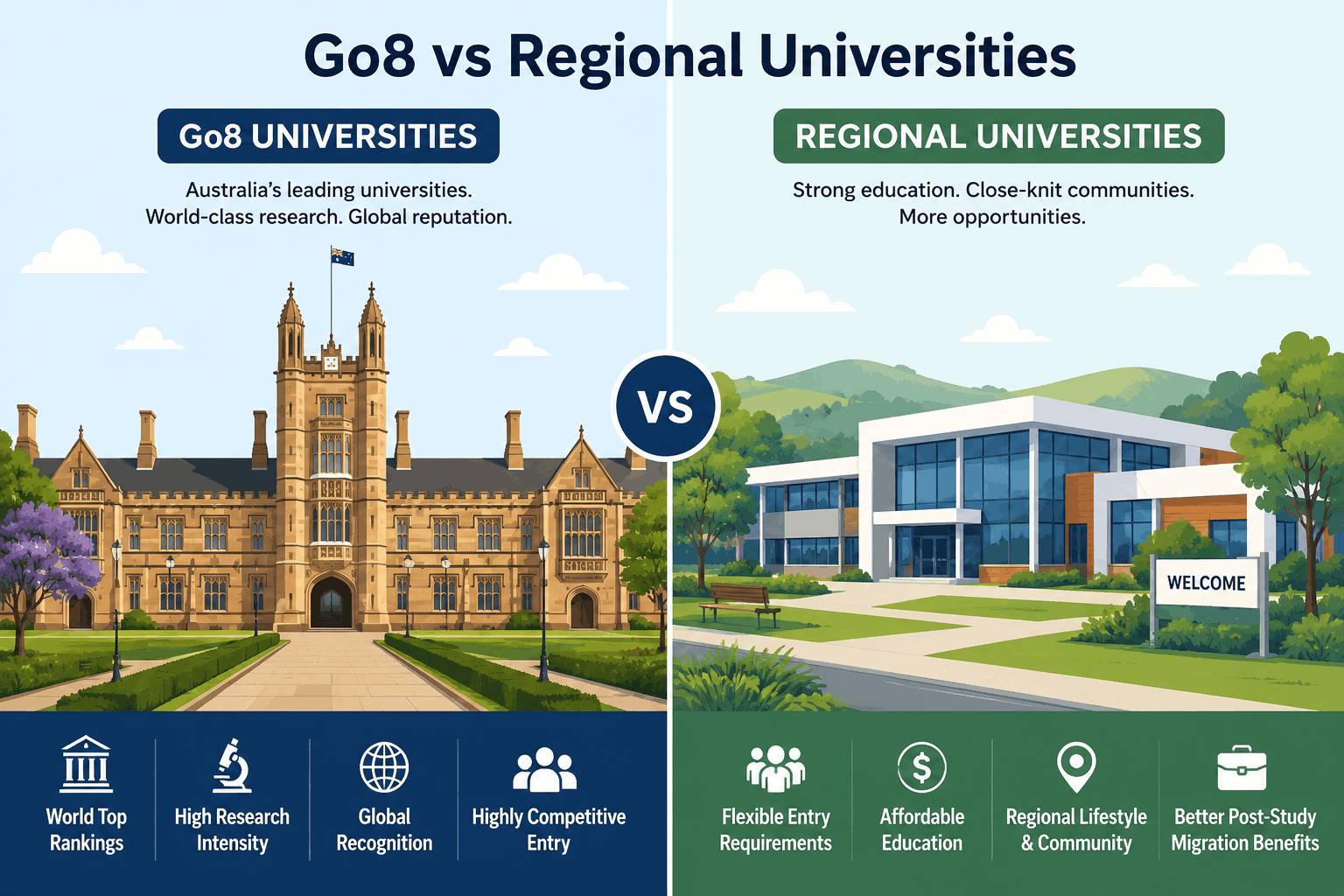
- Group of Eight (Go8) universities — Australia’s most prestigious, research-intensive institutions (think Melbourne, Sydney, ANU, Monash, UNSW) — typically set higher entry benchmarks, both for English scores and academic percentage.
- Regional and newer universities (like Federation University, Charles Darwin University, or University of the Sunshine Coast) often have more flexible entry criteria, while still offering solid teaching quality and, in some cases, better post-study migration points for regional study.
High-Demand vs Standard Courses
Some courses are simply more competitive because more students apply for fewer seats:
- Nursing, IT, and Engineering — Often in high demand due to skilled migration pathways, so cut-offs tend to be stricter.
- Business and Commerce — Popular across almost every university, meaning top institutions can afford to raise their score requirements.
- Niche or specialized courses (like marine biology or agricultural science) — Sometimes have more relaxed entry requirements simply because fewer students apply.
Scholarship-Linked Requirements
If you’re applying with a scholarship in mind, the bar is usually higher than standard admission:
- Merit-based scholarships often require scores well above the minimum — sometimes 75%+ academically and a 7.0+ IELTS.
- Some scholarships also expect extracurricular achievements, leadership experience, or a strong statement of purpose alongside your scores.
Why This Matters for Your Strategy
A score that comfortably gets you into a regional university’s business program might fall short for the same course at a Go8 university. That’s why it’s worth:
- Shortlisting 2–3 universities across different tiers (reach, match, safe options)
- Checking each course’s specific entry page rather than relying on the university’s general average
- Not assuming last year’s cut-off will be identical this year — requirements shift slightly with each intake
Step-by-Step: How to Plan Your Application in 2026
Now that you understand what scores matter for study abroad Australia, here’s a simple roadmap to actually apply.
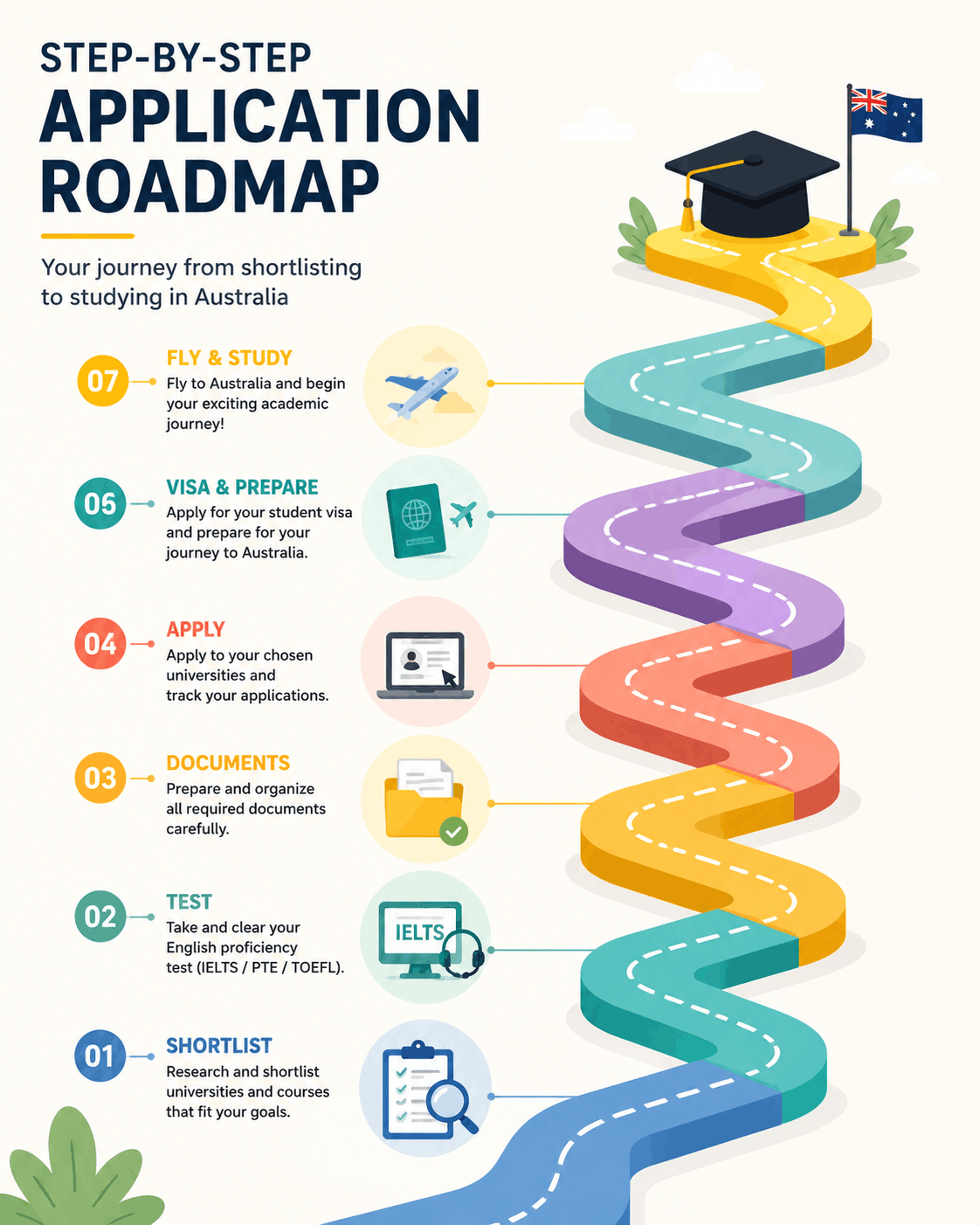
Step 1: Shortlist Your Universities and Courses
Don’t just chase rankings — a good shortlist balances ambition with realism. Here’s how to approach it properly.
Look Beyond the Rankings
Rankings are a useful starting point, but they don’t tell the whole story. Instead, dig into:
- Course curriculum and specializations — Two universities can offer the “same” degree with very different subject focuses, electives, and industry tie-ins.
- Location and living costs — A top-ranked university in an expensive city might cost more overall than a slightly lower-ranked one in a cheaper city, even after tuition is factored in.
- Internship or placement opportunities — Some courses build in mandatory industry placements, which can be a huge advantage for visa and job prospects later.
- Alumni network and job outcomes — Check graduate employment rates and where past students ended up working; this often matters more than the university’s overall global rank.
Build a Tiered Shortlist
A smart approach many counselors recommend is picking universities across three tiers:
- Reach universities — Go8 or highly competitive institutions where your current score is right at or slightly below the average admitted student.
- Match universities — Universities where your score comfortably meets the requirements, giving you a realistic, likely-to-succeed option.
- Safe universities — Regional or newer universities with more flexible entry criteria, acting as a reliable backup.
This way, even if your English test score or GPA doesn’t land you in your dream university, you’re not starting your search from scratch.
Cross-Check Course-Level Requirements
Don’t shortlist based on the university’s general admission average alone. Each course — even within the same university — can have its own separate entry requirements, especially for:
- Competitive fields like medicine, law, or engineering
- Courses with limited seats or high international demand
- Programs that require additional documents like a portfolio, SOP, or interview
Keep a Simple Comparison Sheet
As you shortlist, it helps to track:
- University name and course name
- Minimum IELTS/PTE/TOEFL score required
- Minimum academic percentage/GPA required
- Approximate tuition and living costs
- Application deadline for your intended intake
Having this in one place makes it much easier to compare options side-by-side instead of juggling multiple browser tabs later.
Step 2: Check Entry Requirements Early
This step sounds obvious, but it’s where a lot of students lose time — either by applying too late or by discovering a requirement they weren’t prepared for.
Where to Actually Find Requirements
Don’t rely on aggregator sites, forums, or third-party blogs for exact numbers — they’re often outdated. Instead:
- Go directly to the official course page on the university’s website, not just the general admissions page.
- Look for a section usually labeled “Entry requirements,” “Admission criteria,” or “How to apply.”
- Check both the English proficiency requirement and the academic requirement separately — they’re often listed in different sections.
What to Look For Beyond the Minimum Score
Entry requirement pages usually list more than just a number. Pay attention to:
- Section-wise minimums — Many universities require a minimum score in each IELTS/PTE section, not just the overall band.
- Subject prerequisites — Some courses need specific high school subjects (like physics or maths) completed at a certain grade.
- Work experience requirements — Certain postgraduate courses, especially MBAs, may require 1–2 years of relevant work experience alongside your academic score.
- Additional documents — Portfolios (for design/arts courses), interviews (for some health-related courses), or standardized tests like the GMAT/GRE for select programs.
Revisit Requirements Periodically
Entry requirements aren’t fixed forever — they can shift slightly with each intake based on application volume and university policy. It’s worth:
- Bookmarking your shortlisted course pages
- Checking back every 2–3 months as your application timeline progresses
- Signing up for the university’s newsletter or student portal alerts, if available, so you’re notified of any changes directly
A Simple Habit That Saves Time Later
Every time you check a course’s entry requirements, jot down:
- The exact IELTS/PTE/TOEFL score needed
- The minimum academic percentage or GPA
- Any extra conditions (interviews, portfolios, work experience)
- The date you last checked (so you know if it’s worth re-verifying closer to your application date)
This turns entry requirement research from a repeated scramble into a one-time task you simply update as needed.
Step 3: Take Your English Test Strategically
-
Here’s the expanded version of that section:
Step 3: Take Your English Test Strategically
Your English test score isn’t just a box to tick — it can directly affect which universities and scholarships you qualify for. A little strategy here goes a long way.
Choose the Right Test for You
Not all English tests suit everyone equally:
- IELTS Academic — Widely accepted and well-understood by universities, but the speaking section is face-to-face, which can be nerve-wracking for some.
- PTE Academic — Fully computer-based with faster results (often within 48 hours), which suits students comfortable with typing and computer-based testing.
- TOEFL iBT — Common for students coming from academic backgrounds that follow a US-style curriculum, and increasingly accepted across Australian universities.
If you’re unsure which one to pick, take a free mock test for two of them and go with whichever format feels more natural to you.
Give Yourself Real Preparation Time
- Aim for at least 2–3 months of consistent preparation, not last-minute cramming.
- Take a diagnostic/mock test first so you know your baseline score before committing to a test date.
- Focus extra time on your weakest section — most students lose marks in either writing or speaking, not reading or listening.
Book Your Test With Buffer Time
- Schedule your test at least 6–8 weeks before your application deadline, so you have room for a retake if needed.
- Many test centers get booked up quickly during peak application seasons (especially mid-year and end-of-year intakes), so don’t wait until the last minute to reserve a slot.
If Your First Attempt Falls Short
- Most tests allow retakes, and many students see a noticeable improvement in their second attempt simply from familiarity with the format.
- Focus your retake prep specifically on the section(s) that pulled your score down, rather than restarting your entire preparation from scratch.
- Some universities also accept “one-skill retake” options (like PTE’s one-skill retake or IELTS One Skill Retake), which let you improve a single band score without resitting the whole test — worth checking if your target university accepts these.
Track Section-Wise Scores, Not Just the Overall Band
Since many universities set separate minimums for each section, keep a simple record of:
- Your score in Listening, Reading, Writing, and Speaking (or their PTE/TOEFL equivalents)
- Which section needs the most improvement
- Your test date and result date, so you can plan retakes without missing your application window

Step 4: Gather Your Documents
-
Once your test scores are in place, the next hurdle is paperwork. Most application delays happen here — not because documents are hard to get, but because students start collecting them too late.
Core Documents Almost Every University Asks For
- Academic transcripts and certificates — Official mark sheets and degree certificates for every year of your highest qualification, not just the final year.
- English test scorecard — IELTS, PTE, or TOEFL results, usually valid for 2 years from the test date.
- Statement of Purpose (SOP) — A personal essay explaining your academic background, career goals, and why you’ve chosen that specific course and university.
- Letters of recommendation (LORs) — Typically 1–2 letters from professors or employers who can speak to your academic or professional ability.
- Passport copy — A clear scanned copy, valid well beyond your intended course duration.
- Financial proof — Bank statements, education loan sanction letters, or scholarship confirmation, showing you can cover tuition and living costs (this is also crucial for your visa application later).
Documents That Are Easy to Forget
- Resume/CV — Some postgraduate courses, especially MBAs, expect a formatted resume alongside your SOP.
- Portfolio — Required for design, architecture, or arts-related courses, usually showcasing past project work.
- Work experience letters — If your course values professional experience, you’ll need formal letters from employers confirming your role and duration.
- Gap certificate — If there’s a break in your education timeline, some universities ask for a written explanation or supporting proof.
Get Documents Attested and Translated Early
- If any document isn’t in English, get it officially translated and notarized well in advance — this can take longer than expected depending on your country.
- Some universities also require attested or certified copies rather than plain scans, so check the exact submission format specified on the course page.
Keep Everything Organized in One Place
A simple folder structure saves a lot of last-minute stress:
- One folder for academic documents (transcripts, certificates)
- One folder for test scores (IELTS/PTE/TOEFL PDFs)
- One folder for personal documents (SOP, LORs, resume, passport)
- One folder for financial documents (bank statements, loan letters, scholarship proof)
Label each file clearly with the document name and date, so when the application portal asks for a specific upload, you’re not digging through your downloads folder at the last minute.
Start Early, Not Just “On Time”
Some documents — like recommendation letters or financial statements — depend on other people’s timelines (professors, banks, employers). Starting this process 2–3 months before your application deadline gives everyone enough breathing room, rather than chasing signatures under pressure.

Step 5: Apply for Scholarships (If Eligible)
Scholarships aren’t just a bonus — for many students, they’re what makes studying in Australia financially possible. It’s worth treating this as its own mini-project, separate from your university application.
Popular Scholarships for International Students
- Australia Awards Scholarships — Fully funded, government-backed scholarships aimed at students from specific developing countries, covering tuition, travel, and living costs.
- Destination Australia Scholarship — Offered for students studying at regional campuses, worth up to AUD 15,000 per year, meant to encourage study outside major cities.
- University-specific merit scholarships — Most universities run their own scholarships (often called Vice-Chancellor’s or International Excellence scholarships) based on academic merit, ranging from partial tuition waivers to full-ride coverage.
- Course-specific scholarships — Some faculties (like engineering or health sciences) offer targeted scholarships to attract talented students into specific programs.
Check Eligibility Criteria Carefully
Scholarships usually have their own separate requirements beyond standard admission, such as:
- A higher minimum GPA or percentage than the course’s regular entry requirement
- A specific IELTS/PTE band, sometimes a full point higher than the course minimum
- Nationality or citizenship restrictions (some scholarships are government-to-government agreements for specific countries)
- A separate scholarship application form, sometimes with its own deadline earlier than the course application deadline
Strengthen Your Scholarship Application
Since most scholarships are merit-based, a strong score alone isn’t always enough. Consider including:
- Leadership or extracurricular experience — Student council roles, volunteering, or community initiatives.
- A tailored personal statement — Many scholarships require a separate essay explaining why you deserve the award, distinct from your university SOP.
- Achievements and recognitions — Academic awards, published work, or relevant certifications that set you apart from other applicants.
Apply Early and Track Deadlines Separately
- Scholarship deadlines often fall earlier than the general university application deadline, so don’t assume you can apply “later.”
- Keep a separate tracker for scholarship names, eligibility criteria, required documents, and deadlines, since juggling this alongside your main application can get confusing fast.
- If you’re rejected from one scholarship, check if the university automatically considers you for others — many do this without a separate application.
Don’t Skip Smaller Scholarships
It’s easy to focus only on big-name, fully-funded scholarships, but smaller partial scholarships (10–30% tuition reduction) are often less competitive and can add up meaningfully when combined with a part-time work allowance or family support.

Step 6: Submit Your Application and Track It
Submitting your application isn’t the finish line — it’s the start of a waiting period that needs its own bit of attention and follow-up.
Before You Hit Submit
- Double-check every document against the university’s checklist — missing or mismatched documents are one of the most common reasons for delayed processing.
- Verify your personal details (name spelling, passport number, date of birth) match exactly across your SOP, transcripts, test scorecards, and passport.
- Save a copy of everything you submit, including the confirmation page or email, in case you need to reference it later.
What Happens After Submission
- Most universities take 2–6 weeks to respond, though this can stretch longer during peak intake seasons (especially for the mid-year and end-of-year application cycles).
- You may receive a conditional offer first — one that lists specific conditions (like submitting a final transcript or proof of English score) before it becomes a full offer.
- Some universities request an interview or additional documents at this stage, particularly for competitive courses or scholarship-linked applications.
How to Track Your Application Properly
- Most universities provide a student portal or application dashboard — check it regularly rather than relying solely on email, since some updates only appear there.
- Set up email alerts or filters for your university’s domain so application updates don’t get lost in your inbox.
- Keep a simple tracker noting: application date, current status, any pending documents, and the expected response timeline for each university you’ve applied to.
If You Don’t Hear Back in the Expected Time
- Wait until the university’s stated processing time has fully passed before following up — most portals mention an average turnaround time.
- If there’s no update, send a polite email to the admissions office referencing your application ID, rather than starting a new inquiry from scratch.
- Avoid contacting multiple departments at once for the same query, as this can sometimes cause duplicate processing delays.
Once You Receive an Offer
- Read the conditions carefully — especially deadlines for accepting the offer and submitting your tuition deposit.
- If you’ve applied to multiple universities, compare offers side-by-side (course structure, scholarship amount, city, and start date) before making your final decision.
- Once you accept, you’ll typically receive a Confirmation of Enrolment (CoE), which is required for your Australia student visa application — so keep this document safe and easily accessible.
What If Your Score Isn’t “Good Enough”?
This is a genuine concern for a lot of students, and the good news is — you still have options.
- Pathway programs: Many universities offer foundation or diploma pathway courses that lead into the main degree, with slightly lower entry requirements.
- Retake your English test: Focused prep over 4–6 weeks can often improve your band score significantly.
- Consider alternative universities: Regional and newer universities often have excellent programs with more flexible entry criteria.
- Highlight other strengths: A compelling SOP, relevant work experience, or extracurricular achievements can sometimes offset a slightly lower score.
Remember, a lower score doesn’t mean the end of your plans to study abroad — it just means you may need to explore a different path to reach the same destination.
Common Mistakes Students Make While Aiming for a “Good Score”
- Focusing only on the overall band score and ignoring the minimum required in each section (many universities have section-wise cut-offs too).
- Applying to only “dream” universities without a realistic backup option.
- Underestimating visa-related requirements, which sometimes need a specific English score separate from the university’s own requirement.
- Leaving test preparation too late, resulting in rushed attempts and lower scores.
- Ignoring course-specific requirements and assuming university-wide benchmarks apply universally.
Avoiding these simple mistakes can save you months of stress and repeated applications.
How Much Does It Cost to Study in Australia?
Scores get you in the door, but it’s worth planning your budget alongside your test prep. Here’s a rough idea of what to expect in 2026:
- Undergraduate tuition: Roughly AUD 20,000–45,000 per year, depending on the university and course.
- Postgraduate tuition: Roughly AUD 22,000–50,000 per year, with courses like medicine and engineering on the higher end.
- Living expenses: Around AUD 21,000–25,000 per year for accommodation, food, transport, and other essentials.
- Health insurance: Overseas Student Health Cover (OSHC) is compulsory and typically costs a few hundred dollars per year.
Costs vary a lot between cities too. Sydney and Melbourne tend to be pricier, while cities like Adelaide, Perth, and Brisbane are usually easier on the wallet without compromising on education quality.
Best Cities in Australia for International Students
Choosing the right city can shape your entire experience, not just your degree. A few popular options:
Choosing the right city can shape your entire experience just as much as the university itself. Each Australian city has its own personality, cost of living, and industry strengths — so it’s worth matching your choice to your course and lifestyle preferences.
Melbourne
- Widely considered Australia’s cultural and student hub, with a strong café, arts, and live-music scene.
- Home to top-ranked universities for business, arts, and law, including the University of Melbourne and Monash University.
- Excellent public transport network, making it easy to get around without a car.
- Living costs are moderate to high, especially closer to the city center.
Sydney
- Australia’s largest and most globally recognized city, home to institutions like the University of Sydney and UNSW.
- Strong job market for graduates, particularly in finance, tech, and consulting.
- Iconic lifestyle appeal — harbour views, beaches, and a fast-paced urban environment.
- Tends to have the highest cost of living among Australian cities, so budgeting matters more here.
Brisbane
- Warmer, subtropical climate that suits students who prefer sunshine over cold winters.
- Lower living costs compared to Sydney and Melbourne, without a drop in education quality.
- Growing opportunities in technology, engineering, and renewable energy sectors.
- A relaxed, laid-back vibe compared to the busier southern cities.
Adelaide
- Compact and walkable, making it easy to settle in quickly without feeling overwhelmed.
- One of the more affordable capital cities, popular with budget-conscious students.
- Strong reputation for health sciences, medicine, and research-focused programs.
- Some courses here also qualify for additional regional migration points, depending on visa rules at the time of application.
Perth
- Geographically closer to Asia, making travel home shorter and often cheaper for many international students.
- Strong industry ties to mining, engineering, and natural resources.
- Generally quieter and more affordable than the eastern capital cities.
- Beautiful beaches and a slower pace of life, appealing to students who prefer a calmer environment alongside their studies.
How to Choose the Right City for You
Rather than picking a city purely on reputation, it helps to weigh:
- Course strength — Some cities have stronger industry connections for specific fields (e.g., Perth for mining engineering, Adelaide for health sciences).
- Budget — Living costs can vary significantly, sometimes by AUD 5,000–8,000 a year between the most and least expensive cities.
- Climate preference — Brisbane and Perth offer warmer weather, while Melbourne and Adelaide have more distinct seasons.
- Post-study plans — If skilled migration is part of your long-term plan, check which cities or regional areas offer additional visa points for graduates.

Quick Recap: What’s a “Good Score” for 2026?
| Requirement Type | Minimum Acceptable | Good Score | Competitive Score |
|---|---|---|---|
| IELTS Academic | 6.0 | 6.5–7.0 | 7.5+ |
| PTE Academic | 50–58 | 65–73 | 79+ |
| TOEFL iBT | 60–80 | 90–100 | 100+ |
| UG Academic % | 65% | 70–75% | 80%+ |
| PG Academic % | 60% | 65–70% | 70%+ |
Use this as a general guide, but always cross-check with your specific university and course page before finalizing your test prep goals.
Final Thoughts
Choosing to study abroad Australia is a big, exciting decision — and understanding score requirements shouldn’t feel like solving a puzzle. At its core, a “good score” simply means one that comfortably clears your target university’s requirements while giving you room for scholarship consideration and smoother visa processing.
Aim a little higher than the minimum, plan your test prep early, and always double-check course-specific criteria. Do that, and you’ll be in a strong position to make 2026 the year you start your Australian education journey.
Take it one step at a time — shortlist your courses, lock in your test date, and give yourself enough runway to prepare properly. With the right score, a clear budget, and a city that fits your lifestyle, your study abroad plans can move from “someday” to “sorted” faster than you might expect.
Frequently Asked Questions (FAQs)
Q1. What is the minimum IELTS score required to study in Australia?
Most universities require a minimum of 6.0 overall in IELTS Academic, though this can vary by course and institution.
Q2. Can I study in Australia without IELTS?
Yes, some universities accept PTE, TOEFL, or Duolingo English Test as alternatives. A few also waive the requirement if you’ve studied in English-medium institutions previously.
Q3. Is a 6.5 IELTS score good for Australian universities?
Yes, a 6.5 overall band is considered a solid, competitive score for most undergraduate and postgraduate programs in Australia.
Q4. What GPA is needed for a Masters in Australia?
Generally, a minimum of 60–65% or equivalent GPA is required, though top universities and competitive courses may expect higher.
Q5. Do scholarships require a higher score than regular admission?
Yes, most scholarships are merit-based, so a higher academic and English test score significantly improves your chances of approval.
Q6. How early should I start preparing my study abroad application?
Ideally, start planning 8–12 months before your intended intake to allow enough time for test preparation, document collection, and application processing.
Q7. Which Australian cities are most affordable for international students?
Cities like Adelaide, Brisbane, and Perth generally offer lower living costs compared to Sydney and Melbourne, without a major drop in education quality.
REFERENCE LINK:
TOEFL (ETS): https://www.ets.org/toefl.html