
Every year, lakhs of students across India wait with pounding hearts for one moment — the NEET result. And 2026 was no different. On 16th July, the National Testing Agency (NTA) finally declared the Re-NEET UG 2026 Result, and the numbers tell a story worth understanding if you’re planning your MBBS journey.
If you’re trying to make sense of your scorecard, compare it with past years, or simply understand where you stand, this NEET Result Breakdown 2026** will walk you through everything — in plain, simple language, backed by real numbers and trends.
Why This Year’s NEET Result Matters More Than Usual
NEET 2026 wasn’t a routine exam cycle. It followed a re-conducted exam process, which meant added scrutiny, tighter security protocols, and a slightly different candidate pool than a typical year. That context matters when you’re comparing your score to previous years — the conditions weren’t identical, so a simple year-on-year number comparison doesn’t always tell the full story.
This is exactly why a proper NEET result breakdown — one that looks at percentiles, category-wise cut-offs, gender trends, and rank distribution together — gives you a much clearer picture than just staring at your raw marks.
NEET 2026 Result: The Big Picture
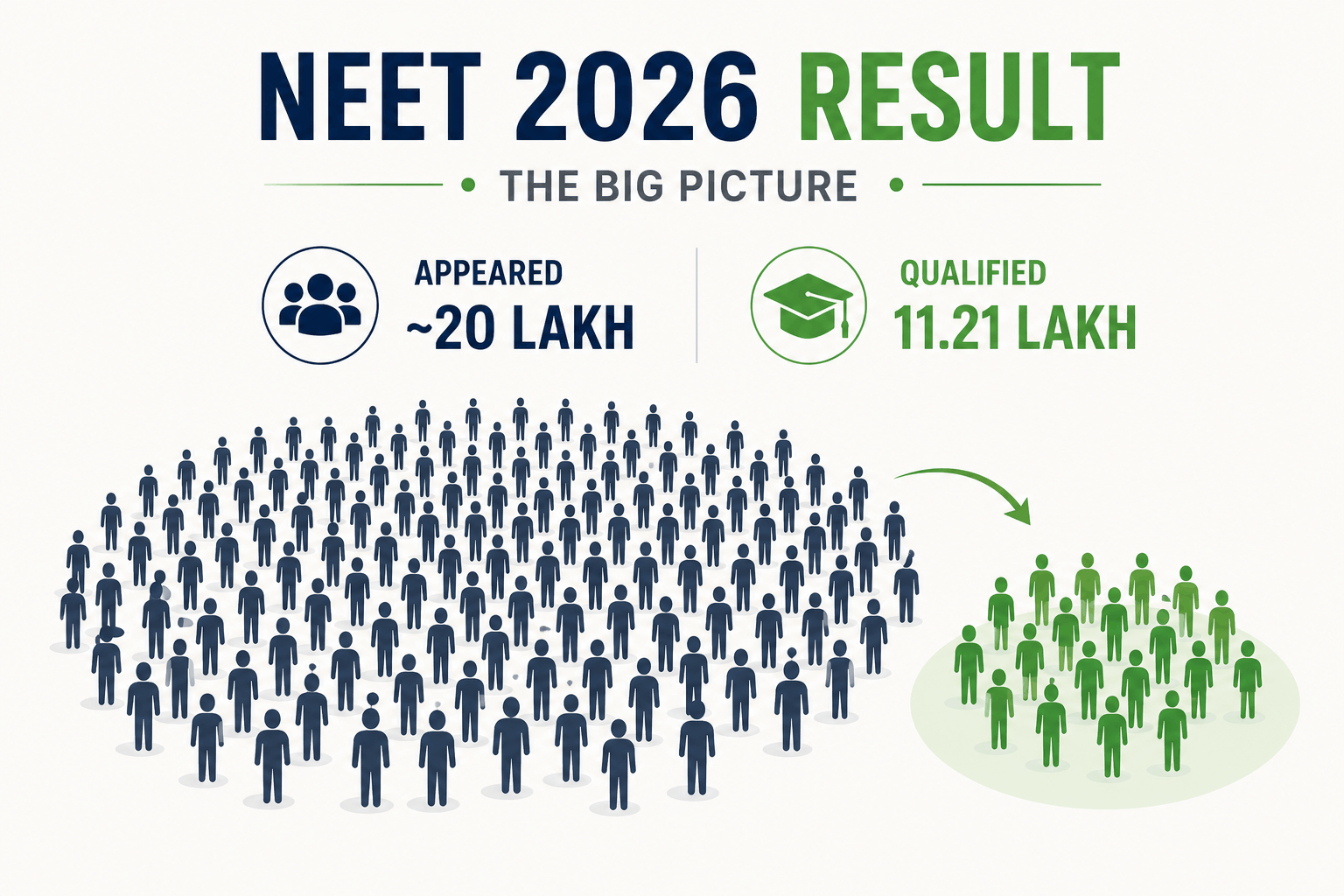
Let’s start with the headline numbers.
– Nearly 20 lakh candidates appeared for NEET UG 2026
– 11.21 lakh candidates qualified the exam
– The exam qualifies students for MBBS, BDS, AYUSH, and allied medical programmes
Compared to the last couple of years, the number of qualified candidates has gone down slightly. But don’t let that number alone worry you — a dip in qualifiers usually means the competition at the top has gotten tighter, not that opportunities have disappeared.
In fact, a smaller pool of qualifiers combined with a higher cut-off often signals that the exam is getting more selective at every level, not just at the top. That has direct implications for how you should plan your counselling strategy later in this guide.
Who Topped NEET 2026?
This year’s toppers list had a rare twist — a joint AIR 1.
– **Aryan Gupta** (Punjab) and **Panshul Bansal** (Haryana) jointly secured **AIR 1** with **715 out of 720 marks**
– **Uplakshya Goyal** from Rajasthan claimed **AIR 3**
Interestingly, a huge chunk of the top scorers were first-time NEET takers. More than 93% of the 138 candidates who scored above 690 marks were attempting NEET for the very first time. That’s an encouraging trend for students who are giving NEET a shot in their first attempt this year.
This pattern is worth paying attention to if you’re a dropper (repeat candidate). It doesn’t mean repeaters can’t top the exam — many toppers historically have been second or third attempters — but it does suggest that fresh, well-structured first-attempt preparation is proving highly effective under the current exam pattern.
The Biggest Trend: Women Are Leading the Way
If there’s one pattern that has stayed consistent — and even grown stronger — in NEET results over the last few years, it’s the rising performance of female candidates.
– More than **58% of all qualified candidates in 2026 were women**
– The female qualification rate stood at **56.8%**, higher than the male qualification rate

This isn’t a one-off. Female candidates have been outperforming their male counterparts in NEET for a few years running now, and it reflects a genuine shift — more young women are choosing medicine as a career, and more of them are clearing one of the toughest entrance exams in the country to get there.
Why This Trend Is Happening
A few factors seem to be driving this shift year after year:
– **Rising enrolment** of girls in science streams at the higher secondary level
– **Better access** to coaching and online preparation resources in smaller towns
– **Family and social encouragement** toward medicine as a stable, respected career path for women
– **Consistent study habits**, which multiple education surveys have linked to stronger performance in objective, time-bound exams like NEET
Whatever the reason, this is a trend that’s reshaping the future face of India’s medical workforce — and it’s a genuinely positive story buried inside a lot of dry statistics.
NEET Cut-Off Trend: 2024 vs 2025 vs 2026
One of the most useful things you can do with your NEET result is compare it against recent years. Here’s how the cut-off story has unfolded:
– **NEET 2024** saw unusually high scores and a record number of top rankers
– **NEET 2025** brought some moderation — scores and cut-offs came down from the 2024 highs
– **NEET 2026** saw a partial return of high scores at the top, but overall qualifying cut-offs shifted upward
For instance, the General category cut-off jumped from **144 marks in 2025 to 213 marks in 2026**. That’s a significant jump, and it carries an important lesson: don’t just aim to scrape past the cut-off. Aim well above it, because the “safe score” keeps moving.
NEET Cut Off 2026: Category-Wise Qualifying Marks
Here’s the official category-wise qualifying cut-off (out of 720) released by NTA along with the NEET 2026 result:
| Category | Qualifying Percentile | Cut-off Marks Range |
| General | 50th percentile | 715 – 213 |
| EWS | 50th percentile | 715 – 213 |
| OBC | 40th percentile | 212 – 177 |
| SC | 40th percentile | 212 – 177 |
| ST | 40th percentile | 212 – 177 |
| UR/EWS – PwBD | 45th percentile | 212 – 194 |
A quick note: this is the **minimum qualifying cut-off** needed to be counted among the 11.21 lakh qualified candidates — it is *not* the score you need for an actual government MBBS seat. The “safe score” for a government college is usually much higher, especially for General and OBC categories.
Why Percentile-Based Cut-Offs Confuse Students
A lot of students get confused because NEET cut-offs are declared as a **percentile**, not a fixed number of marks. Here’s the simple explanation:
– The percentile stays roughly the same every year (50th percentile for General, 40th for reserved categories)
– But the **marks equivalent** to that percentile changes every year, depending on how tough the paper was and how the overall candidate pool performed
– That’s exactly why the General cut-off was 144 in 2025 but 213 in 2026 — the percentile rule didn’t change, but the marks needed to hit that percentile .
Understanding this one concept alone clears up most of the confusion students have every result season.
Score vs Rank: What Does Your Marks Really Mean?
A lot of students get their marks and immediately panic or celebrate — without knowing what that score actually translates to in terms of rank. This is where a **NEET Rank vs Marks** table becomes genuinely useful.
Based on the official NEET UG 2026 result statistics, here’s an approximate marks-to-AIR breakdown:
| Marks (out of 720) | Expected AIR Range | What It Means |
| 715 | 1 – 2 | Topper zone (AIR 1) |
| 700+ | 50 – 100 | Only 19 candidates scored 700+ |
| 650+ | 4,000 – 9,000 | 1,492 candidates crossed 650 marks |
| 600 | 15,000 – 25,000 | Strong for government MBBS |
| 550 | 40,000 – 60,000 | State quota / mid-tier colleges |
| 500 | 80,000 – 1,20,000 | Consider private colleges or allied courses |
Note: These are indicative ranges based on the official result statistics and past trends, not an NTA-published rank predictor. Your exact AIR may vary — always confirm your rank on your official scorecard.
The key takeaway: rank compression has been a real factor in 2026. That means the difference between two candidates’ ranks can shrink quickly as scores rise, so every extra mark counts more than you’d think — a jump from 600 to 650 marks alone can move you up tens of thousands of ranks.
What Is Rank Compression, Exactly?
If you’ve never heard the term before, rank compression simply means that a lot of candidates are bunched together within a narrow marks range. When thousands of students score within a few marks of each other, even a single extra correct answer can shift your rank by hundreds or thousands of positions.
This is precisely why NEET toppers and coaching experts constantly emphasise accuracy over guesswork — in a compressed rank zone, one wrong guess can cost you far more than just four marks.
State-Wise and Category-Wise Performance
NEET results aren’t just a national story — they vary a lot by state and category. Some patterns worth noting:
– States like **Punjab, Haryana, and Rajasthan** produced this year’s top rankers
– **SC candidates** need to cross the 40th percentile to qualify, similar to previous years
– **ST candidates** also follow the standard 40th percentile qualifying norm
If you want a precise picture of where you stand, always check the **category-wise and state-wise cut-off list** released alongside the official result, rather than relying only on the general cut-off.
Why State Quota Matters As Much As All India Quota
Many first-time NEET candidates focus only on the All India Quota (AIQ) counselling and overlook their state quota seats — which is a mistake. Since 85% of MBBS seats in most states are reserved for state-domicile candidates, your **state-level rank** often matters more for admission chances than your **All India Rank**.
If your state has a lower average competition (fewer applicants relative to seats), even a modest AIR can translate into a very good state rank — and a real shot at a government medical college.
What Should You Do After Checking Your NEET Result?
Once you’ve gone through your **NEET result breakdown**, here’s a simple action plan:
1. **Download your scorecard** from the official NTA website
2. **Check your percentile and All India Rank**, not just your raw score
3. **Compare your rank with previous year’s cut-offs** for your target colleges
4. **Register for counselling** (MCC for All India Quota, or your respective state counselling body)
5. **Keep your documents ready** for verification before choice filling begins
Documents You’ll Likely Need for Counselling
Getting your paperwork ready early can save you a lot of last-minute stress. Commonly required documents include:
– NEET admit card and scorecard
– Class 10 and 12 mark sheets and certificates
– Category certificate (if applicable) — caste, EWS, or PwBD certificate
– Domicile/residence certificate (for state quota)
– Passport-size photographs (as per counselling authority specifications)
– Valid government ID proof (Aadhaar card, passport, etc.)
Keep both physical copies and scanned digital copies ready, since different counselling rounds may ask for either format.
Avoid falling for fake calls or websites promising guaranteed seats — NTA has repeatedly warned candidates about such scams.
Official Sources to Bookmark
For anything related to your result, cut-off, or counselling, rely only on these official portals:
– **neet.nta.nic.in** — NTA’s official NEET result and scorecard portal
– **mcc.nic.in** — Medical Counselling Committee (MCC), for All India Quota counselling
– Your respective **state counselling authority website**, for state quota seats

Common Mistakes Students Make After Seeing Their Result
Even capable students sometimes make avoidable mistakes right after the result comes out. Watch out for these:
– **Panicking over a lower-than-expected score** without checking the actual cut-off and rank context
– **Ignoring state quota options** and focusing only on top government colleges through AIQ
– **Delaying document preparation**, which can cause last-minute stress during choice filling
– **Filling too few choices** during counselling, reducing the chances of seat allotment
– **Falling for private consultants or agents** who claim to guarantee seats for a fee
Avoiding these mistakes alone can meaningfully improve your counselling outcome, regardless of what your final score turns out to be.
Final Thoughts
This **NEET Result Breakdown 2026** once again proves that the exam keeps evolving — **NEET Cut Off 2026** figures shift, competition intensifies, and new trends emerge every single year. Whether it’s the rising dominance of female candidates, the return of high scorers at the top, or the increasing importance of scoring well above the minimum cut-off, one thing is clear: consistent preparation and realistic goal-setting matter more than ever.
Once you’ve made sense of your **NEET Result 2026**, checked where your **NEET Rank vs Marks** stands, and shortlisted your target colleges, the next big step is **NEET Counselling 2026** — so keep your documents and preferences ready well in advance.
If your result wasn’t what you hoped for this time, remember that NEET gives you the chance to try again. And if you’ve qualified, this is just the beginning of an exciting journey ahead.
FAQs on NEET Result Breakdown 2026
Q1. When was the NEET UG 2026 result declared?
The NEET UG 2026 result was declared by NTA on 16th July 2026.
Q2. How many candidates qualified NEET 2026?
Out of nearly 20 lakh candidates who appeared, 11.21 lakh candidates qualified the exam.
Q3. Who topped NEET 2026?
Aryan Gupta from Punjab and Panshul Bansal from Haryana jointly secured AIR 1 with 715 out of 720 marks.
Q4. What is the General category cut-off for NEET 2026?
The General category qualifying cut-off for NEET 2026 stands at 213 marks, up from 144 marks in 2025.
Q5. Did female candidates perform better in NEET 2026?
Yes. Over 58% of qualified candidates were women, and their qualification rate of 56.8% was higher than that of male candidates.
Q6. What should I do immediately after checking my NEET result?
Download your scorecard, check your rank and percentile, compare it with previous cut-offs, and register for counselling through the official channels.
Q7. Is the NEET cut-off the same as the score needed for a government MBBS seat?
No. The cut-off is just the minimum qualifying mark. Actual admission to government MBBS colleges usually requires a much higher score, depending on your category and state.
Q8. Should I focus on All India Quota or state quota counselling?
Both matter, but since a large share of MBBS seats are reserved for state-domicile candidates, your state quota rank is often just as important — sometimes more important — than your All India Rank.
Q9. What documents are needed for NEET counselling 2026?
You’ll typically need your NEET scorecard, class 10 and 12 certificates, category certificate (if applicable), domicile certificate, photographs, and a valid ID proof.
Q10. Can repeaters still score well in NEET?
Yes, absolutely. While a large share of this year’s top scorers were first-attempt candidates, repeaters have historically also secured top ranks with focused, structured preparation.
NEET 2026 Cut-Off Trends (2024 vs 2025 vs 2026) — https://www.pw.live/neet/exams/neet-2026-results-cut-off-trends-neet-2024-vs-2025-vs-2026